Best Of Archives - Page 16 of 16 - Itch.world
A three-minute escape to Italy.
Tuscany, travel, medieval village, Italy, festivals, celebrations, customs, cooking, recipes, living in Italy, moving to Italy, visiting, visit, restaurants, language
40
archive,paged,category,category-best-of,category-40,paged-16,category-paged-16,wp-theme-stockholm,ajax_fade,page_not_loaded,,select-theme-ver-4.4.1,paspartu_enabled,wpb-js-composer js-comp-ver-7.9,vc_responsive

I park, therefore I am

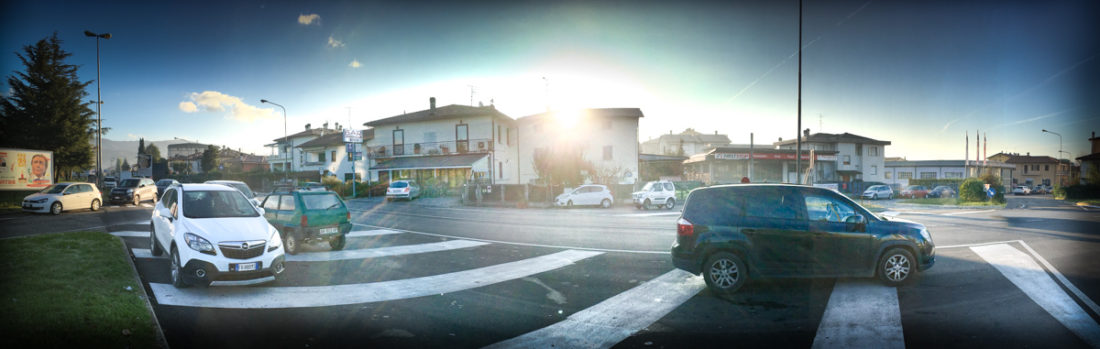
The Tuscans are astoundingly pragmatic about life and I delight in seeing how this pragmatism plays out in daily life. Take the act of parking, for instance, which seems to be elevated to a fundamental right of freedom and self-expression. If there’s a large section of pavement across from your favorite bar, which happens to be a striped traffic island, who says it can’t also be a perfectly good place to park? After all, no one is supposed to be driving there, anyway, and a traffic island is a waste of good real estate.

As an overall rule, the lines painted on the pavement of parking lots are only vague suggestions of where cars should go, or how many cars fit in the lot. Many, many more can fit in as long as there are good manners and common sense used about never blocking someone in.
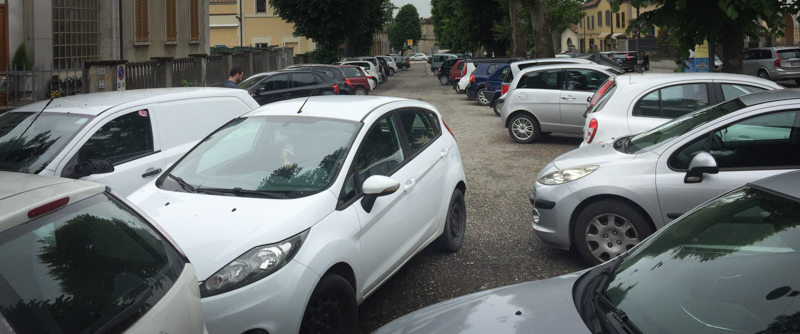
There are a number of parking lots I have noticed with no exit. The only way out is to backup the length of the lot, hoping no one is coming in at the same time. This system accommodates more cars in a lot and everyone just works around the inconvenience for this reason.
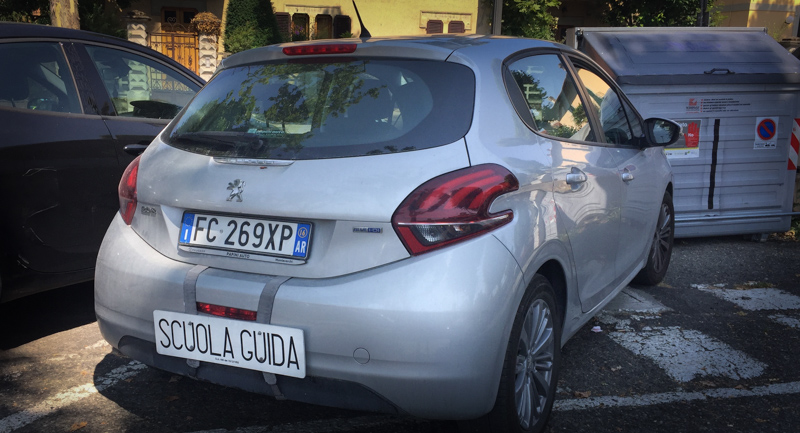
This is one of my favorite parking moments, for so many reasons. It’s a car from the official driving school (the one John and I took driving lessons from, which is a whole other story…). This parking lot is full, so the driving school instructor decides to park illegally in front of the trash dumpsters. What isn’t in the photo is that there is a huge lot right next to this one that is nearly empty, but you have to pay 70 cents to park there, so clearly it’s much better to ignore the no parking zone and park in front of the dumpster.

But the real story is that all of this somehow works. The driving instructor knows when the trash truck comes by and will need access to the dumpster, and that it is fine to block it for now. The police wouldn’t ticket for the same reason—you can’t really expect someone whose office is opposite and is constantly in and out of their car to park in the pay lot.

About a month after we’d moved to our village I’d parked the car in the square overnight, as we often did. When I returned the next morning I was surprised to find that it was now the only car there, and that the weekly market had sprung up surrounding it. Even more surprising, we hadn’t been ticketed. It turned out the police knew the car of the new Americans in town and cut us some slack because we weren’t yet up to speed on the fine points of village living, like what days the main square is emptied of cars for the market.

I love all of this, and it makes me frustrated when I come back to the U.S. and the rules of parking lots feel rigid, with no opportunity for creativity, common sense, and freedom of expression. In any given parking lot there is so much wasted space because people are parking only between the lines. I see parking opportunities everywhere, just ripe for seizing, if you are willing to break the rules.


0
0

No tips here

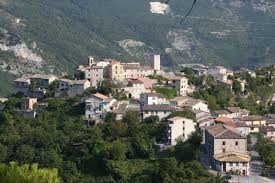
After our trip to the mother of all caves we were hungry. Nearby we found a village, Pierosara, with 140 inhabitants, a monastery from the year 1,000, and a wonderful restaurant, da Maria.

We came in about 2:45, very late for lunch, even by Italian standards. A woman greeted us and I tried to tell her that we would eat quickly, but somehow it came out that we wanted to eat right away (and be done quickly). I saw her face fall and felt the temperature in the room drop suddenly. I reached deep in my Italian language warehouse to explain that I was worried about their closing time, that we were so late, and that we would keep them. Everything shifted.

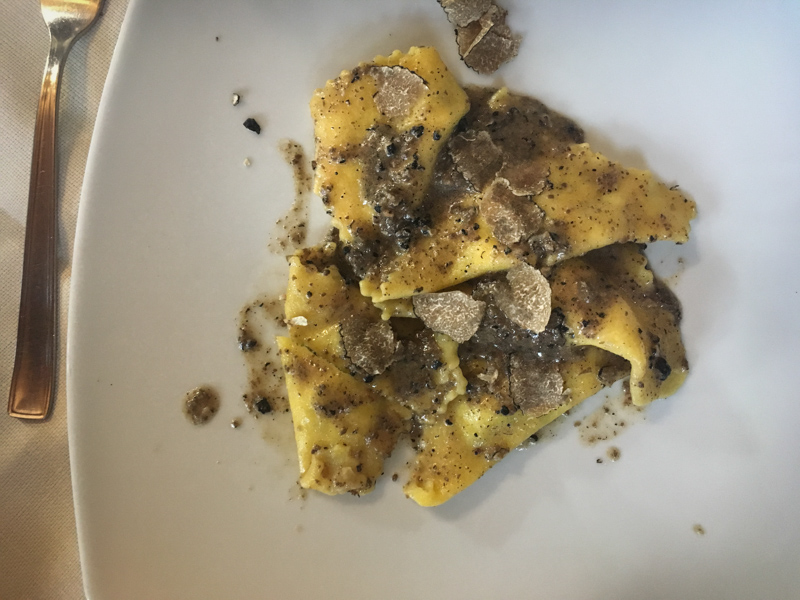
We were shown to the last table—every other was packed for a lingering Sunday lunch. We had fresh, homemade ravioli with truffle sauce and a steak, and were both completely unhurried and warmly welcomed. As the restaurant emptied out, we were one of two tables left, and they began to set up for dinner.

I started to think about the difference between service in Italy and the U.S. (and elsewhere in the world.) The kind of ease and sweetness we often experience was so different from the forced “Hello, my name is Andrew and I will be your server. How are we doing tonight?” kind of greeting. Her disappointment when she thought we wanted to hurry the meal (even if our lingering resulted in their inconvenience), the absence of pressure to leave so they could “turn the table,” the lack of any pretense; it’s all fundamentally different. I’ve rarely felt a forced note here in a restaurant, unless I am in a highly-touristed center.

It often feels like you are being invited into someone’s home, with the equivalent sense of a meeting of equals. I think a small part of this is because service is always included, as a “coperto,” or cover charge, per person. In the U.S., discretionary tipping may add to the feeling that dining out is merely an economic exchange of money for food and service.

But I think it really has to do more with something core in the Italian character that has fascinated me since we moved here six years ago. Italians simply seem more secure and full of self-respect than Americans (and from what I’ve seen, of Brits) where you are only as “worthwhile” as your university, last project, round of funding closed, academic paper published, weight, brand of shoes…

This Italian ease in the world is a tonic for my soul, and something I will be studying, with mouth agape, for years.

0
1

The pasta we can’t quit (and recipe)

When I want a mini-vacation—and lunch—I head to the sleepy Tuscan hilltop village of Monterchi. In the piazza at the top is one of my favorite family restaurants, Ristorante Al Travato.

It’s only open from-kinda-around-Easter to kinda-around-the-end of October, depending on the weather and the back health of Laura. The family first opens the restaurant on weekends only, then slowly builds, with the heat, to being open most days in summer, and then winds it all back down in the fall. What they do all winter I am not sure, although they’ve hinted it involves skiing.

Marco, Laura’s husband, finds the wines for the cellar—a cave that goes back into the medieval walls—and Laura cooks. Two of their teenage daughters serve (yep, beauties. We can even get our 14-year-old son to eat there whenever we want), while the youngest daughter rides around the square on her small, enviable pink bike.

Our family craves one dish in particular, at least once a week— Spaghetti Aglio, Olio e Pepperoncini—true Tuscan soul food. It’s spaghetti that’s properly al dente, loads of garlic, and a few really hot peppers, all swimming in olive oil.

While it’s simple in its ingredient list, differing opinions of how it should be made abound. You could say of Laura’s (off-menu version): “questo spacca di brutto” (“this chops off the ugly”—I know, the translation doesn’t help me either, but the kids say it means something is a big deal). Best of all for anyone who wants to bring a bit of Italian soul food into their kitchen, it’s easy enough to do tonight with ingredients you probably already have on hand.

Here’s a two-minute video on how Laura makes the definitive Tuscan comfort food.

A cooking note: you’re going to save some of the water from cooking the pasta when you drain off the rest. Also—do this before the pasta has reached the “al dente” (still slightly firm when bitten) state. It will finish cooking when added to the pan with the other ingredients (while the last bit of cooking water helps their flavors go inside the noodles).

0
0

Rooster ring tone

There’s the most fantastic rooster who wakes me up every morning. So ready for the stew pot, partial cock-of-alzheimer’s, partial been-out-too-late drinking. Indescribable call. So I decided not to try, but to go one better.

One Sunday morning around 5am I decided to track him down. Armed with a mic and recorder I drove down to two different chicken coops in nearby fields and stealthy, like the fog, sneaked around until I heard my mystery rooster.

He is now properly recorded, and turned into a ring tone because I wanted it, which means that at least one of you probably does too. And no roosters were harmed in the making of this post.


0
0

So I find myself…

…sitting in a house that’s somewhere between 400 and 800 years old in a Tuscan village thinking about what to do if I meet a wild boar again while taking a walk, business development for the company I run, what one more year in an Italian high school will mean for my teenage son, and what to have for dinner—all at the same time.

We are almost six years into the adventure of responding to a deep, unrelenting urge to change our lives, an itch, if you will, that inspired our move to Italy—enrolling the kids in the local school (where they started off not speaking any Italian), working with clients all over the world from our homebase in this Italian village, and finding our way in a new life.

Friends, understandably, ask questions. “Do the kids feel more Italian or American, and which parts of their attitudes come from which culture?” “What do the locals think of you?” “What do you actually do all day—don’t you get bored? ” “Where can we go in Venice to escape the crowds and see real neighborhoods?” “Where should we get dinner in Florence?”

So lately I’ve discovered a different kind of itch—a desire to answer these questions and more. Hence the birth of Itch, my notes about food discoveries, language insights, surprising cultural moments, and ideas for adventures in Italy, shared as we live them, weekly.

I invite you to come along for the journey and share with like-minded friends.


0
5