Live Archives - Page 11 of 13 - Itch.world
A three-minute escape to Italy.
Tuscany, travel, medieval village, Italy, festivals, celebrations, customs, cooking, recipes, living in Italy, moving to Italy, visiting, visit, restaurants, language
39
archive,paged,category,category-live,category-39,paged-11,category-paged-11,wp-theme-stockholm,ajax_fade,page_not_loaded,,select-theme-ver-4.4.1,paspartu_enabled,wpb-js-composer js-comp-ver-7.9,vc_responsive

Ho! Ho! No.

I recently returned from London where I completed my tour of duty of some of the centers of the holiday universe: Regent Street, Liberty, Fortnum and Mason, Covent Garden … No one does Christmas like the Brits. Masterful holiday lights, bustling crowds, beautiful ornaments and decorations for the home, special things to eat, and, of course, everything you could imagine to buy as gifts.
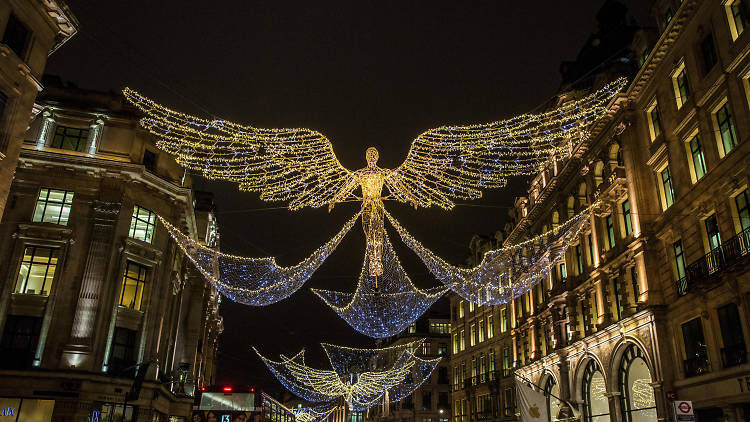
thanks to Jeff Moore and Time Out

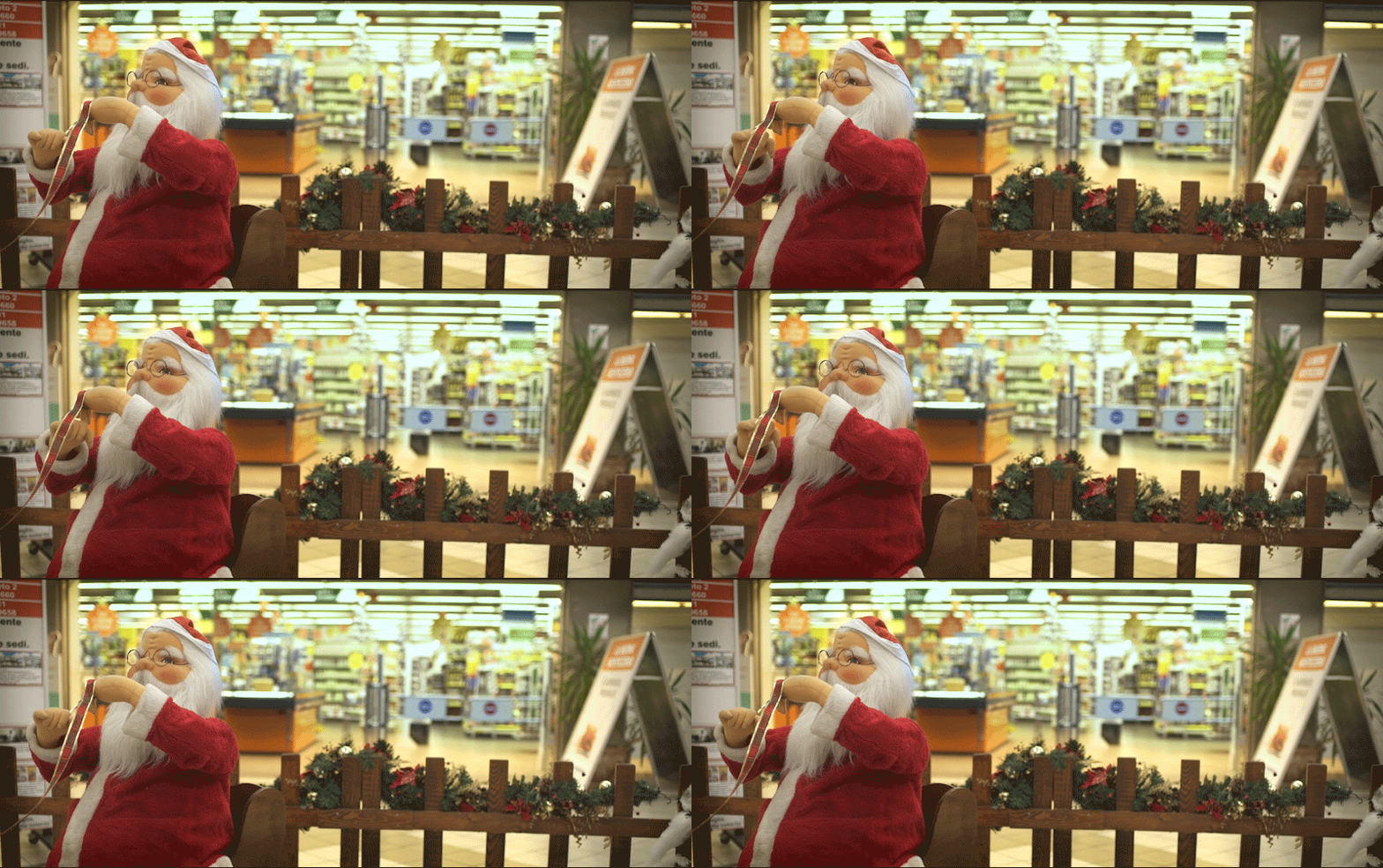
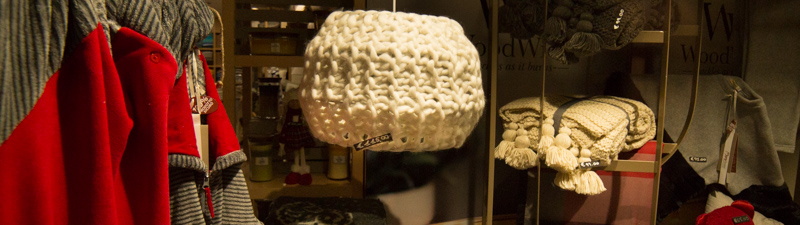
Then I returned home. Our valley is a kind of anti-matter to the London-style Christmas. The first few years we lived here I was stunned by the fact that there was virtually nothing to buy. Or to decorate the house with. Or to wrap presents with. Present options in our piazza include special housecoats to clean in. The farm stand has gift baskets with green peppers and celeriac. And there is this knitted lamp shade. The Santa (shown above) from the grocery-store-anchored mini mall sums it up.
There’s panforte, panettone, and things with truffles, but they can hardly compete with the goods on display in a big city. (There are exceptions to everything, of course. The family-run Busatti linens sold in the valley are revered around the world.) There’s none of that frenzied shopping bustle and long lines, except at the butcher.
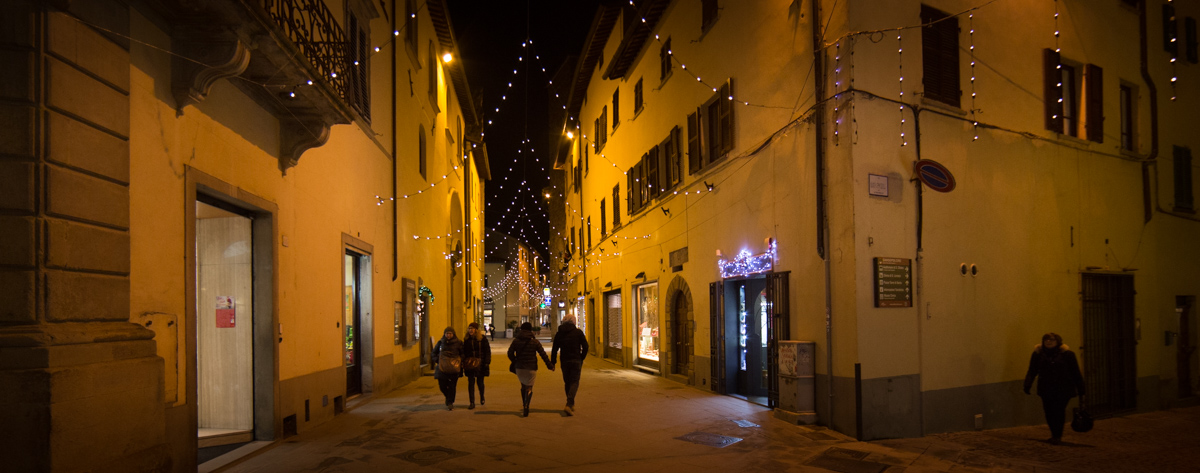
I love this more relaxed version of Christmas. It was easy for me to think that my identity was defined by the presents I gave and how well-decorated my house was, but this world has offered up a different way to be during the holidays. Last year when I went to the sports store to buy ski wear there was only one set of choices, and you are lucky if they had the right size. There isn’t that treadmill of decisions about brands, performance, price, taste, and style.

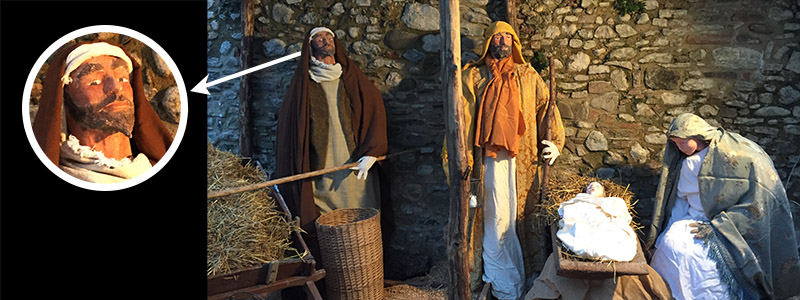
Despite the lack of commercial Christmas cheer, I’ve never felt it more deeply. Everyone you meet greets you with an “Auguri!” and kiss. While running errands tonight I stopped by a church from the year 700, a stone’s throw from our house, while they were setting up the nativity scene. It gave me chills.

And this grabbed my attention as much as the lights over Piccadilly—what’s really going on in this life-sized manger scene near the piazza?
0
0

Learn to be an Italian driver

John and I had lived in Tuscany for just over a year when we realized that our American drivers’ licenses were no longer valid in Italy. Unfortunately, we discovered the process of getting an Italian license is one of the most rigorous in the world. There are 10,000 possible questions on the exam. You get randomly assigned 40 on your test, which you have to answer in 30 minutes, and get four or less wrong to pass. And it is only in Italian.

The best way to approach this challenge is through a “scuola guida,” or local driver’s school. It is a sort of rite of passage in which sweaty teens and terrified expats are on a level playing field.

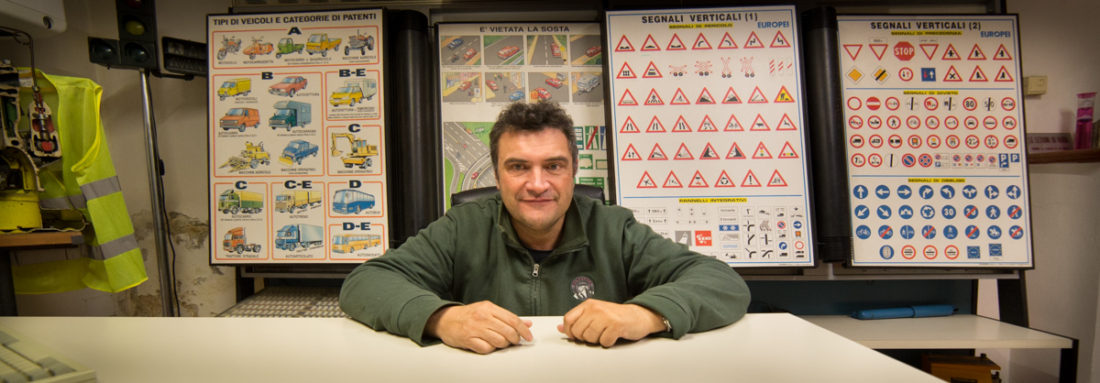
Our instructor for the written test thought it was better if John and I were taught apart from the teens, in a kind of “special” student way. We, and one other friend, arrived three times a week to a typical classroom with rows of desks and a big screen up front. A noticable difference from the usual classroom environment was the tire calendar with topless women on the wall.

Every week our instructor would run through his slides, a selection of possible test questions, and try to mime and convey in very loud and slow Italian what the question was about. John and I had been married for ages by that point, but we discovered a new aspect of our relationship—that we became cut-throat competitors when academic superiority and glory were on the line. Who first yelled out  “vero” or “falso” to a question became a matter of pride.

The questions are intentionally tricky. “When you happen upon an unfortunate by the side of the road with a possible thoracic spine injury do you move them to an incline of 30-degrees?” “Does a 50cc. scooter have brake fluid?” “Is a pregnant woman required to wear a seat belt?” Sometimes I understood the question, but had no idea of the answer. Other times my language would reach its limit at an important moment: “When your car stalls within 10 meters of a train track do you cojidhfp immediately?” (Answer key: vero, vero, falso, and I still don’t know.)

The best part of this process was the relationship between the instructor and the class. It’s hard to imagine the lack of ego, endless humor, sense of equality between instructors and students, and amount of abuse that is coming your way when you enter the classroom. Our daughter, Donella, is currently taking the class and says that all of them laugh nonstop.

The class was asked: “If you happen upon an unfortunate by the side of the road, who is on fire, do you extinguish the person or wait for the fire to go out?” The instructor advised, while rubbing his hands together and with an evil grin, that actually “falso” might be the appropriate answer, because with a little olive oil, rosemary, and garlic … There’s a kid in the class who is the latest generation of a long line of morticians in our village. Unfortunately, for him, much discussion in class is about the possible dangers of driving—some possibly fatal. With great glee, the instructor always extrapolates to the worst outcome, then refers to the situation as being great for the mortician’s business.

This week one of the instructors was telling off someone in the class for an answer he thought was stupid, and kept yelling “Curse on those who teach you,”—implying himself. It reminded him of a recent trip to the post office that had amused him greatly. He was looking for parking, noticed a car leaving, and put on his turn signal to wait for the spot. The other driver seemed incapable of getting out of a parallel parking position—spending several minutes moving back and forth without making any progress. The long line of waiting drivers were getting impatient. Finally, our instructor got out, knocked on the window, which was rolled down, and he was greeted with a big smile. He told the woman how to get out of the parking spot. Turns out he’d taught her how to drive two years ago. He thought it was hilarious that she still couldn’t park.


0
1

How are you?

“How are you?”

Such a routine question. “Come stai?” But try asking a distant acquaintance (or any random stranger) on an Italian beach in summer and brace yourself for the hour-long conversation that will follow.

Answers will detail how many hours slept and the quality of sleep, the state of bowels and urination, if the appetite is normal, how the stomach feels, if there are any sore muscles, how healthy teeth and gums are, and if there is any hint of a headache.

If any blood tests have been done recently the conversation will cover key results, and how to improve any findings that are off, such as cholesterol. Descriptions will follow of diets tried, the miracle of kiwis, herbal remedies, new pills on the horizon, special yoghurts, or anything that will fix whatever item needs improvement.

If you are at the centre of the universe then every day you need to have an awareness of the most important thing in the world—you.

By going abroad I was surprised that internal systems seem to work without monitoring. Bowel movements, sleep patterns—these things work without constant checking!

And equally surprised that the last thing we monitor is our true selves, our souls. As if we expect it all to work. As if it does not matter.

0
0

Italy in London?

On a recent trip to London I visited an Italian restaurant, Bernardi’s, which I’d read about in a Bloomberg review.

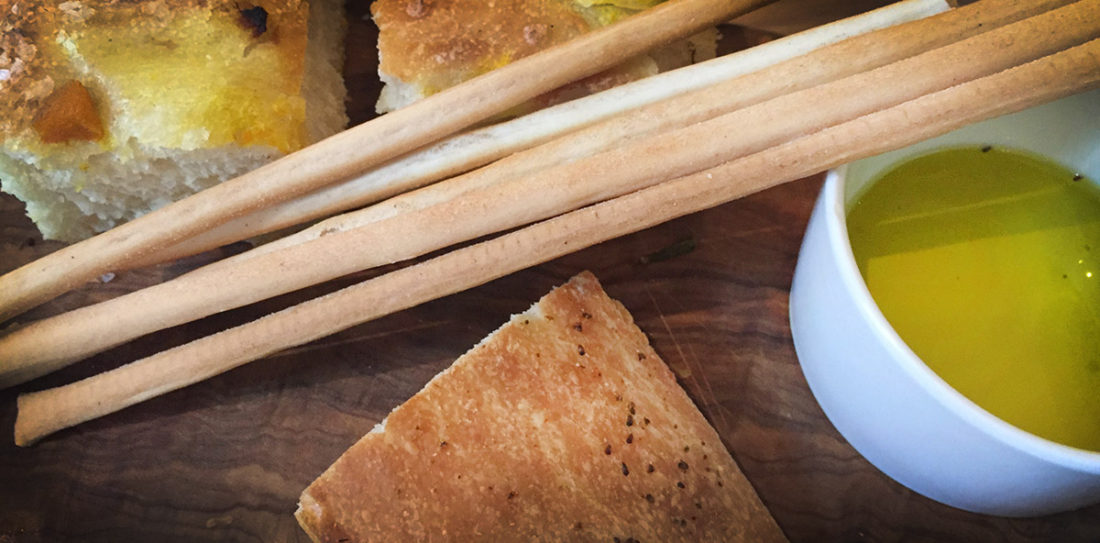
A starter arrived with some focaccia and olive oil and I started to talk with the waiter about the oil, which was surprisingly fresh and peppery. He told me was from Puglia, the only source for real olive oil, according to him.

He’d moved to London five years ago, and was soon to make his first trip back to Italy since he’d left. During the five years his extended family had visited nine times, including his 98-year old grandfather, who was a builder (“muratore,” or literally “builder of walls”) and is illiterate. His grandfather had never traveled much in Italy, let alone been on a plane, until his grandson moved to London. He’s now confident in airports, and loves to come to London, where he walks for hours, comparing building techniques. My waiter friend had just bought his first flat in his new home. Somehow his move had not only worked out well for him, but given a gift of adventure to his whole family.

Even in the middle of Marylebone I realized, yet again, what I love about the Italians.  I remembered John telling me about the Italian woman he’d met on a plane, who had moved to Australia, who said that the thing she’d noticed most about the Italian diaspora is that they always land on their feet. I think that has something to do with a certain lightness about life.

On my walk to the restaurant I happened to pass a hotel where I’d stayed with my parents when I’d first moved to London for a year right after I’d graduated from university. Seeing the hotel brought back the feeling of fear my parents and I had in our stomachs that week—at the time, London was as foreign to my family as Mars. Looking back I can’t believe that my parents had the kind of trust in me (and the universe), support, and courage to let me listen to my heart and move. I am sure they knew in their souls that what they were seeding would eventually take me far away from them. That year in London ended up being one of the greatest adventures, and most important experiences, of my life. And it did result in my moving far away, permanently.

Bravi to the parents, and grandparents, who have the courage to set their children free to find their own paths, and find ways to expand their own worlds. May I be as bold.

0
0

Let’s talk about money

Death, sex, money, obscenities—the rules are hard enough to determine in your native culture and language. I find discovering how another culture handles them a constant fascination. The Tuscans are in-your-face frank about so many things that I would have expected that money would be near the top of the list, but there seems to be this slight reluctance to demand payment mixed with honesty, the assumption of honesty on the part of customers, and a lack of urgency about getting paid that I don’t yet fully understand.

So many examples… Lola, our dog, was very sick this summer, which required once or twice daily visits to the vet for a month, complete with blood tests, IVs, and ultrasounds. She was finally declared cured so I asked to pay. The vets said they were busy with other things and to worry about it later. I followed up a series of calls and texts to get the bill, and a month or so later they finally totaled it up, texted me the total, and I was able to pay them.

In this area of Italy, when you eat at some restaurants you don’t get a bill.  You go to the register and recite what you had and they tell you how much. Simple when it’s a couple of people, but groups of kids commonly go to these places —like 15-20 people—for birthday parties and other celebrations, and then go up, one at a time, and pay for exactly what they had. And it all seems to work.

At first, I thought these types of experiences were simply a function of being in a small town, but then John went to a medium-sized city about 45-minutes away to rent a rototiller for a few days. They load this three thousand euro piece of equipment in the back of the car and jot down his first name and phone number on a piece of scrap paper and he drives away. No deposit. No credit card taken. No ID. And no surprise when he returned it two days later.

One year we found a Christmas tree (late) tall enough for our living room even further away from the house. The guy cuts down a 15-foot tree to size, carefully loads it on the car, we choose a second smaller tree, and then realize he doesn’t accept credit cards. His solution is to give us his bank account number so that we can transfer money to him later rather than having to worry about finding cash that evening. “Con calma!” “No hurry!” he yells after us as we drive away with the trees.

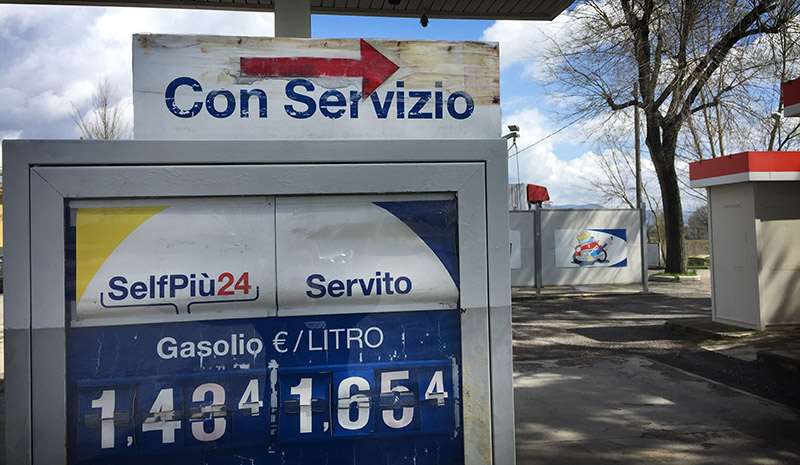
One day the car needed gas so I stopped at a local station. It was cold and I didn’t want to pump it myself so I pulled into full serve. The older guy who owns the station came out, waving me to back up and move the car over to the self-serve pump. I assumed that it was because the other pump was broken, but no, he says “That one’s too expensive!” and proceeds to fill the tank himself.

My daughter, Donella, and I returned to this station about a month later badly needing windshield washing fluid. We had just filled the car up at another station where they were out of the fluid we needed, so we stopped here. I went in to buy a bottle and the same man comes out, insists on filling up the fluid reservoir, and washing all the windows for us, then charges us one euro for the solution. We pulled out, a little stunned, and Donella’s reaction was “How can this world even exist?”

I have no idea how much we owe our dentist at the moment, post braces, wisdom teeth surgery, and multiple cleanings, but we will get it all sorted out, at some point. And the price is always more than fair.

The Tuscans often pride themselves on being furbo (crafty, fox-like), and thrifty, so I find it hard to reconcile these traits with this seeming lack of urgency about getting paid, and an assumption that people will pay. Homogeneous culture? (But we are clearly outsiders, albeit with the “right” kind of passport.) Or perhaps a desire not to contaminate daily life with too much fixation on finances? I haven’t got an answer for you now, but will write more as I learn.


0
0

An Italian Thanksgiving takes a village

November, 2012. It’s our first Thanksgiving in the village. Six weeks earlier we’d moved into our rented home for the year. The entire place consisted of four nuns cells, and the wide corridor connecting them, in a convent from the 1600s in the “new” part of town. We decided to celebrate, and boldly invited over 20 new friends, some of whom had never celebrated Thanksgiving before.

We had a lot of logistics to solve. Where was everybody going to sit? How do you get a whole turkey in Italy? Was it even possible to cook this much food in our tiny kitchen, which took up half of one of the 12′ by 12′ nuns cells, the small dining table claiming the other half of the space?

Then it all started coming together, as friends started to pitch in to help. There’s this wonderful organization in Italian villages, the pro loco, whose only charter is to plan and run village parties. This organization is well-staffed and equipped. One friend explained our lack of tables and chairs for a big party to the pro loco, and they lept into action, delivering five banquet tables and two dozen chairs to our door. This sounds much easier than it was, as our door was on the third floor of this ancient convent, reached through a massive front door from the street, down a long, dark, wide entry corridor that led into the open cloister, across the cloister, up three flights of twisting stairs, then down another corridor. Finally our door. Miraculously, two days before the event we found furniture from the village stash leaning against the walls.

Now for the turkeys. The butcher in the square said he’d never sold a whole turkey, but he’d call a farmer and make the arrangements. When we went to pick them up he disappeared into the walk-in cold storage and then two large turkeys were pulled to the front of the shop, hanging upside down on hooks mounted on the overhead track that runs the length of the store. These were not your average Butterball, all neatly trussed and demure. Nope, these guys had reached rigor mortis totally spread eagled, wings and legs splayed. He stuck each one into its own large plastic bag, but neither bag was large enough to contain the whole bird without various limbs poking out.

Our friends own a linen company, Busatti, and offered to bring the linens they used for parties. Another friend had a small apartment, with an oven, down the hall, so we were able to spread cooking between two apartments. An earlier visitor from California had brought cranberries in her suitcase. A few pumpkins are grown in the Valley and could be turned into pies. All the tables fit, end to end, in our long corridor.

It always feels slightly odd to be away from the U.S. for Thanksgiving because life in the rest of the world carries on, oblivious to the holiday in the U.S. It’s hard sometimes to make it feel special. But this Thanksgiving I will always smile about. I am still thankful for these people, and this place—but that first year was a revelation, realizing that somehow we’d landed on our feet in our new life in Italy.

0
0

I park, therefore I am

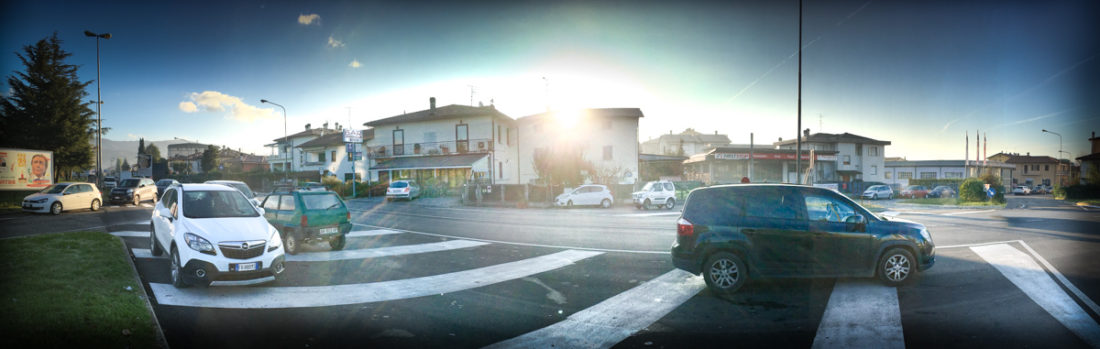
The Tuscans are astoundingly pragmatic about life and I delight in seeing how this pragmatism plays out in daily life. Take the act of parking, for instance, which seems to be elevated to a fundamental right of freedom and self-expression. If there’s a large section of pavement across from your favorite bar, which happens to be a striped traffic island, who says it can’t also be a perfectly good place to park? After all, no one is supposed to be driving there, anyway, and a traffic island is a waste of good real estate.

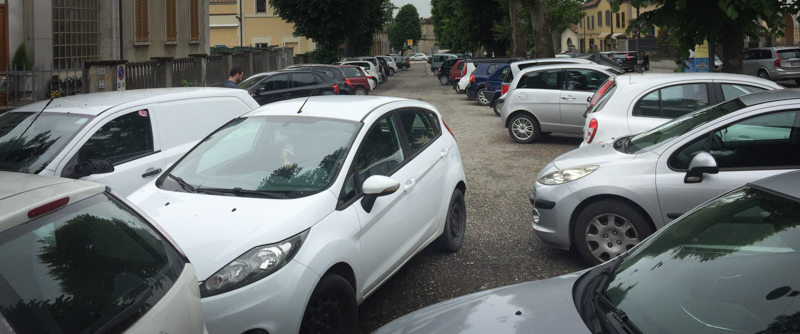
As an overall rule, the lines painted on the pavement of parking lots are only vague suggestions of where cars should go, or how many cars fit in the lot. Many, many more can fit in as long as there are good manners and common sense used about never blocking someone in.

There are a number of parking lots I have noticed with no exit. The only way out is to backup the length of the lot, hoping no one is coming in at the same time. This system accommodates more cars in a lot and everyone just works around the inconvenience for this reason.

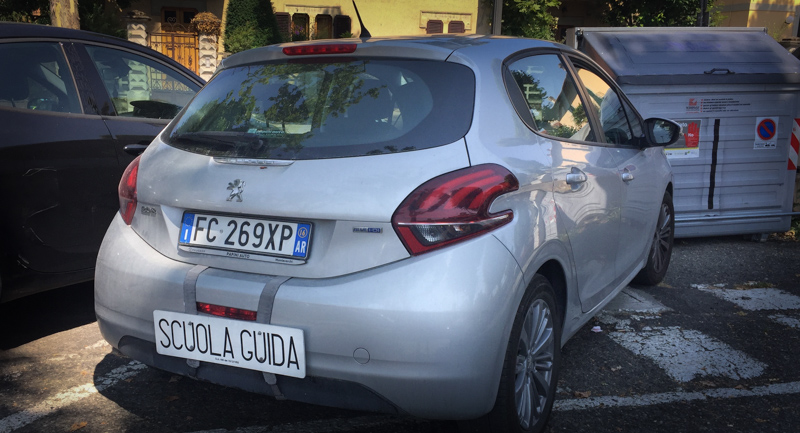
This is one of my favorite parking moments, for so many reasons. It’s a car from the official driving school (the one John and I took driving lessons from, which is a whole other story…). This parking lot is full, so the driving school instructor decides to park illegally in front of the trash dumpsters. What isn’t in the photo is that there is a huge lot right next to this one that is nearly empty, but you have to pay 70 cents to park there, so clearly it’s much better to ignore the no parking zone and park in front of the dumpster.

But the real story is that all of this somehow works. The driving instructor knows when the trash truck comes by and will need access to the dumpster, and that it is fine to block it for now. The police wouldn’t ticket for the same reason—you can’t really expect someone whose office is opposite and is constantly in and out of their car to park in the pay lot.

About a month after we’d moved to our village I’d parked the car in the square overnight, as we often did. When I returned the next morning I was surprised to find that it was now the only car there, and that the weekly market had sprung up surrounding it. Even more surprising, we hadn’t been ticketed. It turned out the police knew the car of the new Americans in town and cut us some slack because we weren’t yet up to speed on the fine points of village living, like what days the main square is emptied of cars for the market.

I love all of this, and it makes me frustrated when I come back to the U.S. and the rules of parking lots feel rigid, with no opportunity for creativity, common sense, and freedom of expression. In any given parking lot there is so much wasted space because people are parking only between the lines. I see parking opportunities everywhere, just ripe for seizing, if you are willing to break the rules.


0
0

Bringoli: in praise of fat spaghetti

In Italy, it seems as if nearly anything is a possible subject for a celebration—I think it’s part of what makes the culture so joyful. One of the key celebrations around these parts is to honor a really fat spaghetti, called bringoli. And because I am dedicated to deepening your knowledge of pasta, you get to celebrate bringoli too.

I wouldn’t have guessed that fat spaghetti would be highly seasonal, but apparently it is, and late autumn is its moment. November 11, specifically, La Festa di San Martino. Apparently Martin, a Roman soldier, was standing guard one bitterly-cold night in 335 CE, and gave half his cloak to a very underdressed merchant. He spent the rest of the night freezing and hallucinating. In the morning, he promptly converted to Christianity.

I think he’s one of the better saints because there are great feasts in his honor all over Italy, celebrating the new wine, various local cookies, meatballs, and even one for radicchio, up near Venice. But here in the Valtiberina (Valley of the Little Tiber—the headwaters of the famous river), La Festa di San Martino means it’s the time for bringoli.

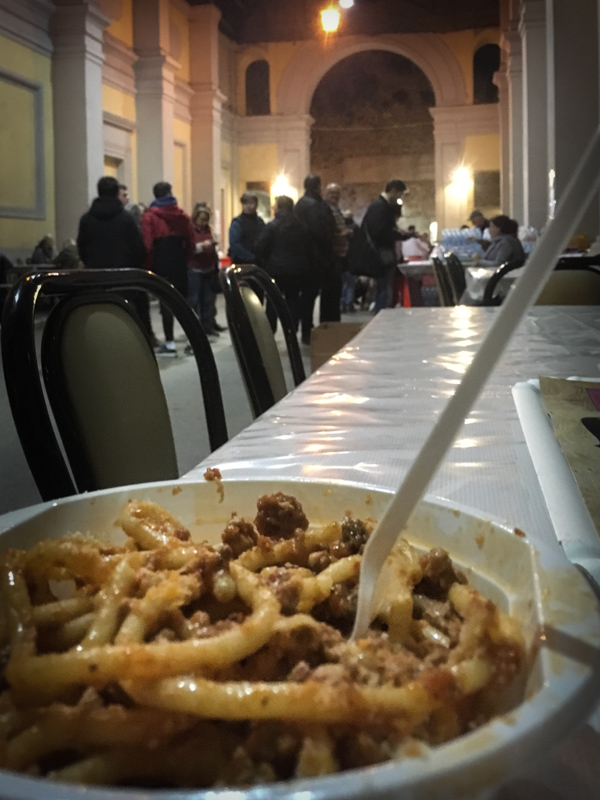
It’s an unassuming little festival, with several volunteers in one tent cooking bringoli with either a meat or a mushroom sauce, served up in a little plastic bowl. The actual cooking happens behind a kind of screen, which is mysterious. Perhaps it is to protect proprietary village secrets. The volunteers served our two portions with ragu, and were running behind on making the mushroom sauce for our third serving. By the time the mushroom bringoli was ready they decided to replace our original two with hot ones, as pasta is not something you eat cold.

This being Tuscany, there are plenty of open fires—when they grill something, the Tuscans do it over a fire that they’ve burnt down to embers, rather than using charcoal briquettes, and there are elaborate grilling carts to make it possible to keep a fire producing usable coals all evening. Over the flames volunteers roast sausages and toast bread that is rubbed in garlic and drenched in olive oil. (If you take hard, white Tuscan bread and toast it until it gets a little charred over coals, the bread not only gets slightly infused with smoke, but gets a texture not unlike sandpaper, which lets you grate down a half a clove of raw garlic when you rub it into the bread.) Other fire tenders roast chestnuts.

As you sit outside in the cold, huddled over your fat noodles and drinking Vino Novello (Italy’s answer to Beaujolais Nouveau) in an arcade under glowing, buzzing fluorescent lights, Italian village magic happens. Everybody is out and socializing, from a couple of four-year old girls twirling in the middle of the street, who clearly believe they are in charge of the whole event, to the packs of teens aware of every micro-movement of their peers, through to the old men and women, laughing with people they’ve known since childhood.

It’s my daughter’s favorite festival of the year, topping even the polenta and fried bread ones. Her friend, who is now studying in Venice (a good four-hour train ride away), came down for the weekend just for it. “He gets it,” she said. It is a unique time when everyone who appreciates anything good in life gathers together to enjoy local food at its simplest and best. It is also a celebration of community and the heart of our town. It’s rare to see anyone from outside town, but you’re almost guaranteed to see everyone from within.

To make your own, feel free to substitute pici, although they are in no way similar, the locals tell me. Top with a lovely ragu or a porcini mushroom sauce.


0
1

What’s the f***ing big deal?

I’m delighted to include an article by our daughter, Donella, who will occasionally chime in with a teenager’s perspective.


On a recent train ride from Florence, I sat near a very sweet Italian boy, who was four, and his mother. They had just left their nonna in Florence, and were already very worried about her whereabouts. Well, the mother was. She wanted to use her phone to check in on the nonna. The son, however, also wanted the phone—to play. He grew impatient with his mother’s fretting and started saying “Ma cazzo mamma eh!”, which translates to “But fuck mom, eh!” At first, I was shocked, but she just laughed, and soon I joined in. They’re just words, right?

That is one of the perks of being a child in Italy; almost no words are off-limits. From middle school on, students can happily swear in class and the teacher will, at most, give the child a scolding look, but more likely will swear right back. This particular freedom of speech lends itself to the very Tuscan mentality of confrontation. Upon reflection, that is the very best thing that happened to me in Italian school: I learned to stand up and defend myself and what I believe in.

Almost no words are off limits. Almost. Some of the most colorful taboo words seem innocuous at first. “Dog,” “pig,” and “cow,” for instance, are tame words, until you pair any one of them with any religious figure. “Diocane” (“god-dog”) is a classic, and is strictly forbidden to use in a classroom, and even more so at home.

This type of swearing is called “bestemmiare,” and essentially means any insult to god. When said in anger it is perceived as much more offensive to God than if it is said in a playful manner, or even to accentuate a sentence. Bestemmie are used by all members of society, old and young (my brother described it as “cool” when he was 12), farmer to president. I remember that one of the most amusing headlines in several national papers a few years ago was when a priest tripped in a procession, and said “Diocane!”

You can take anything, literally anything, not considered to be “nice” and pair it with Dio, Madonna, or Gesu’, and ta-da! you have a bestemmia. You can put your chosen noun before or after the name, and you can be as creative as you want, the essence will always still be there. The most common nouns used are “cane” (dog), “porco” (pig), and “puttana” (slut, referring to the Madonna). However, I have heard many variations, one of my favorites being “diociclope”, or “cyclopsgod”.

People have fun with it, and many people adopt it into almost every sentence, for emphasis, my driving teacher being one of them. It’s a sign of how deeply I’ve internalized Italian culture that, even though I am not religious, whenever I hear a bestemmia uttered in anger, my breath catches in my throat.

0
0

The many time zones of one village

Time moves differently in Italy, I’ve heard people say. A friend from London says that the moment she knows she has arrived in Italy is when she withdraws money from the cash machine in the square, which seems to take about 30 seconds between each step of the process, it feels like geologic time if you’re not used to it.

We used to live in an apartment in old town over a little store. I’d go down each morning to get fresh bread for the kids’ breakfasts before taking them to school. The opening time on the store’s door is definitive: 7:30. One morning, I was still standing by the locked door at 7:45, when the owner finally showed up. I was getting nervous about getting the kids to school on time, so I said, trying to hide my annoyance, “I thought you opened at 7:30.” The very sweet woman who owns the shop replied, totally at ease, “7:30…7:45—uguale.” “Uguale” meaning “equal, no difference.”

The most obvious way that this, more elastic, sense of time plays out is when the bells of the village ring to announce the current time. From various places we’ve lived we’ve heard the bells from several towers tolling the time, twice an hour (depending on which bells are working). You’d think this would be a very predictable thing, and a cacophony every thirty minutes, but it’s not. Each bell takes its time, ringing in seven o’clock, for example, at 7:00, 7:07, 7:10 and up to about 7:12, then taking its turn again in 30 minutes. The half-past bells add an additional beat, with a different tone, before or after the count to signify the half hour. Except for the one that doesn’t, and just rings the hour bell again.

The bells get a bit more aligned after the twice annual shifts for daylight savings time, and then they drift further apart. Time, in a village, is all relative.

I’d like to get deeper into this story and report back. Does one person change the time on the bells or is it done by by different bell keepers? How do they decide which bell is the one that is most accurate, or does it matter?

But for now I want to leave you with a question. The next time you look at your phone or Apple watch to find out the time (when I often get a little thrill knowing I actually know what the exact time is), does it matter if time is relative or absolute, and is it true (and perhaps better) that 7:30 and 7:45 may, in fact, be uguale?


0
0