Live Archives - Page 12 of 13 - Itch.world
A three-minute escape to Italy.
Tuscany, travel, medieval village, Italy, festivals, celebrations, customs, cooking, recipes, living in Italy, moving to Italy, visiting, visit, restaurants, language
39
archive,paged,category,category-live,category-39,paged-12,category-paged-12,wp-theme-stockholm,ajax_fade,page_not_loaded,,select-theme-ver-4.4.1,paspartu_enabled,wpb-js-composer js-comp-ver-7.9,vc_responsive

Raining olives

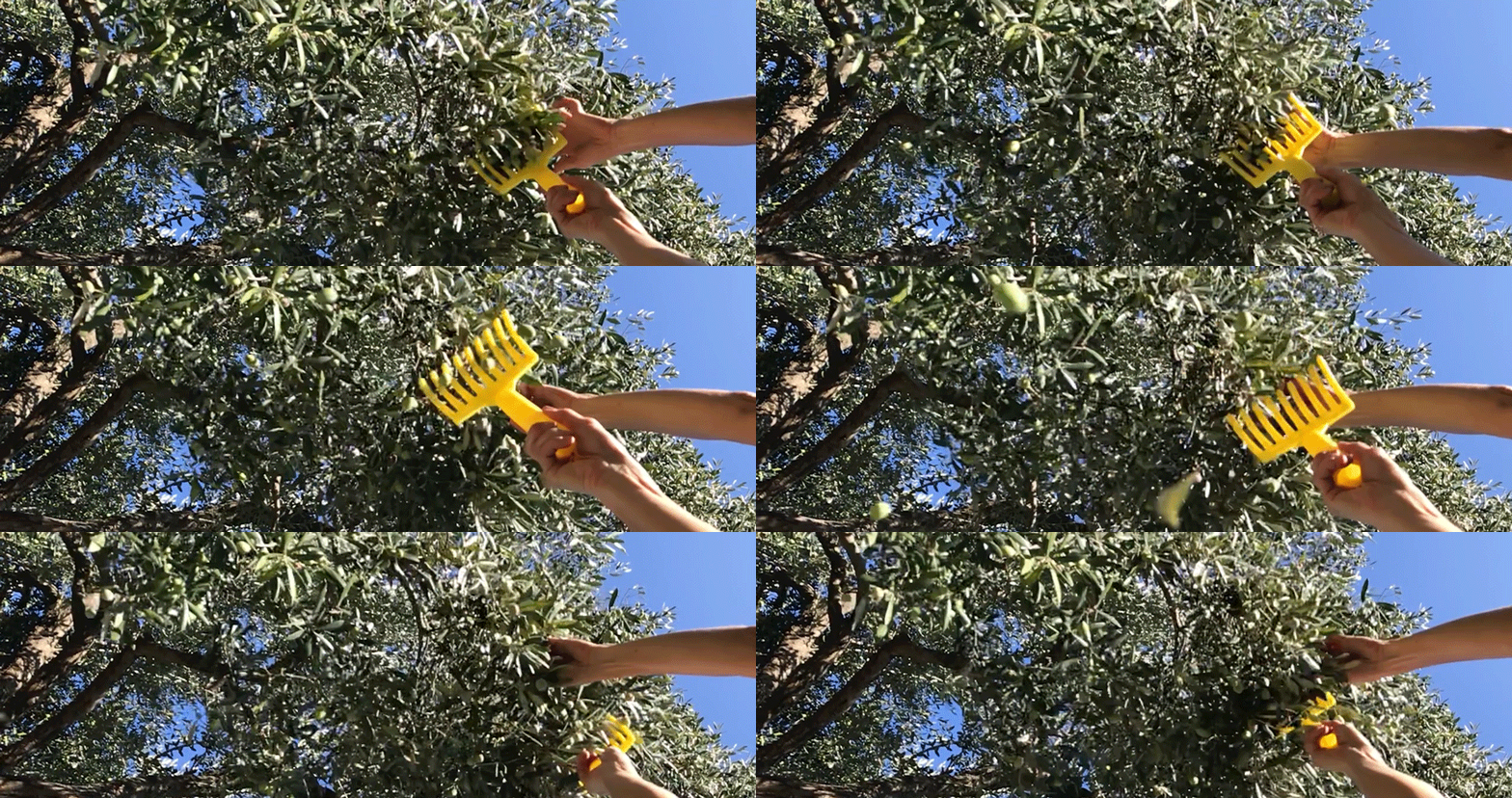
We just pressed the olive oil from our trees. The days of picking are all-consuming: spreading nets under the trees, raking the olives off the branches by hand with small plastic rakes, pouring the olives caught by the nets into plastic crates, and moving the crates to safe storage until the olive oil can be pressed, which should happen no longer than 48 hours from picking. Thankfully, this year we had help, two Americans, a friend and her 19-year old son, coming to Italy for the first time.

The culmination of all of this work is going to the olive oil press, or “frantoio”.
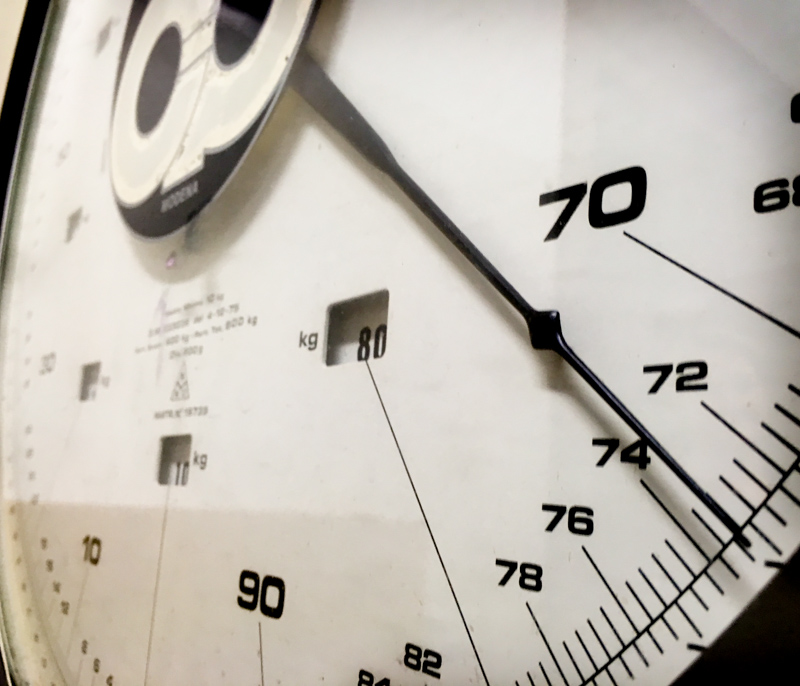
The crates of olives are unloaded and weighed with great import, carefully watched by the others in line for the press. It’s a competitive “I have more olives than you” moment. We do respectably well, olives weighing in at over 500 kilos (over half a ton), in 25 crates. But soon we are put in our place by three very scruffy 40-something guys who came in after us, unloading about 75 crates. “Smug devils,” I think to myself. We eye them. They eye us. No smiles.

We settle in for a long wait. Turns out everybody showed up with twice the amount of olives they’d predicted, slowing down the process from an hour or so to about five. No English is spoken here, so my friends amuse themselves by watching the scene and playing with the various dogs on hand for the press. The guy who runs the press runs around in his black tracksuit, overseeing all.

He decides that our friends’ lack of Italian, and John and my limited understanding, does not hinder communication in the slightest when it comes to the important topics of life. He pulls us over to look at the olives unloaded by the three guys. “Idiota!,” he tells them, encouraging John and our 19-year old visitor to chime in with their opinion of the three. Turns out they had used mechanized rakes, getting a great yield, but bruising the olives in the process, and mixing in a lot more twigs and leaves than is desired. The guys didn’t blink, complimenting our smaller yield on the lack of leaves, twigs, and bruises. All are laughing and chatting away now. These guys remind me that Tuscan men seem to have a lot more fun than men in other countries.

The woman of the mill shows up with plates of freshly baked cookies, crackers, and bread, drizzled with just-pressed oil and salt, which she enthusiastically passes. Mr. Mill decides it’s time to get out the wine just as we are starting to pour our boxes of olives into the press, which is the last chance to pick out sticks, leaves, and any olives that don’t look worthy. We are all trying to do final quality control, leaning over the large open funnel leading to the grinder, while balancing our never-empty plastic cups of wine and a constantly replenished supply of bread with olive oil, crackers, and cookies that the owners watch carefully that we finish.
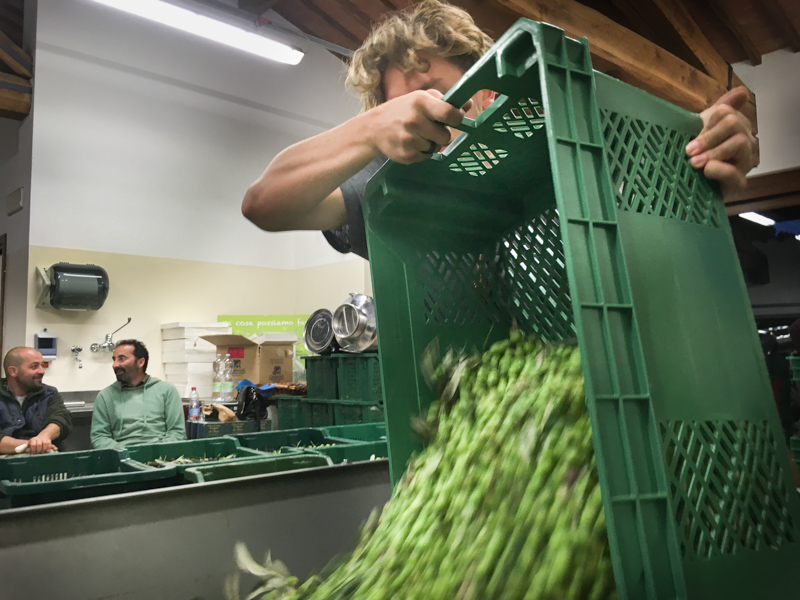
Our new press buddies in the background.

Finally the oil comes streaming out. It is a record harvest for us—more than 100 liters when we are finished with all the trees. Dark green and very peppery.

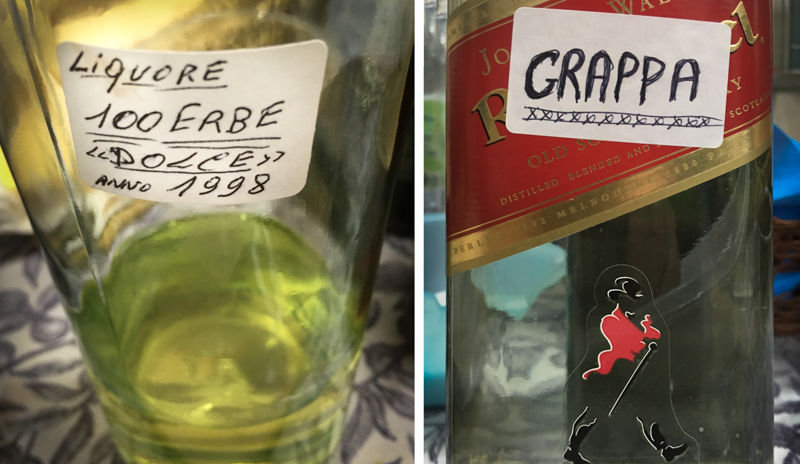
And to celebrate the owners decide that it is time to bring out the special grappa.


0
0

Feeling cozy in an Italian cemetery

This story started out to be about the cemetery, in honor of Halloween. As my Itch stories often do, it ended up being about something different. It is about death, but also about love and community. After all there are two holidays that follow All Hallow’s Eve: All Saints Day, and All Souls Day—days for remembering and affirming family and friendship.


One dark, rainy, winter night I decided to walk home, alone, from a nearby pizza restaurant so I could get more steps on my fitness tracker. I took the route that goes by the cemetery, and instead of walking by it, I decided to go in.

We live near this cemetery. I drive by it multiple times a day, see a steady stream of people walking by our front gate going on their daily visits, and witness funeral processions coming from the church at the top of the hill down our narrow lane to the cemetery. The hearse drives by, followed by a priest chanting on his loudspeaker, and a stream of mourners on foot. Despite this proximity, I hadn’t yet ventured inside the cemetery gates.

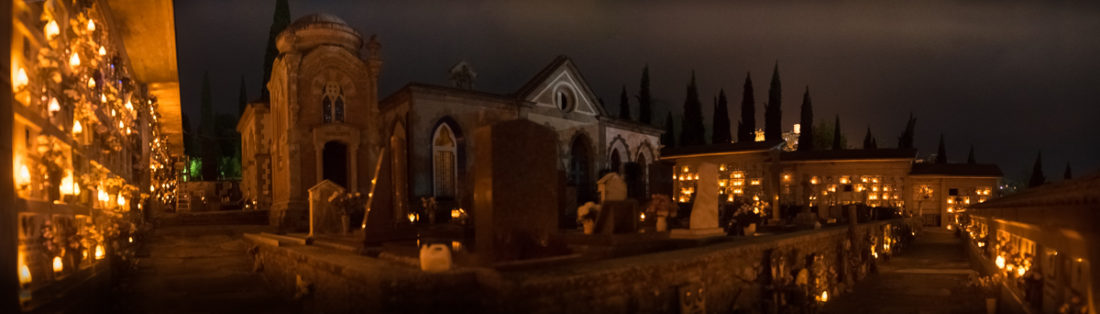
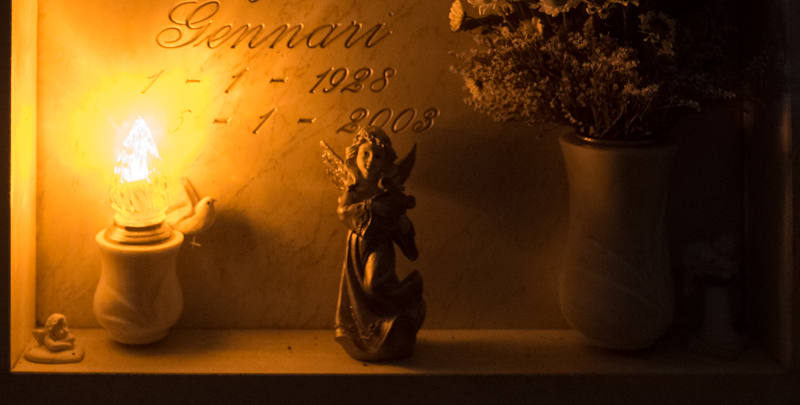
Italian cemeteries are special places, obviously well-visited and loved. The density of tombs is impressive, stacked five high in a sort of high-rise condo complex of mortality. It feels somehow warm, crowded, and social. I think it is due to the quirky humanity of the decorations that crowd the shelf-edge of nearly every nook. Battery-operated candles are the only lights in the graveyard at night (and there are so many that it is well lit), and one or two plastic floral arrangements in ceramic vases are crowded on every shelf, next to multiple figurines. Photos abound, which give a glimpse of the personality and passions they had in life. The gates are not locked at night, although the cemetery is officially closed, and none of the floral arrangements or figures of small angels are fixed in place.

That night I was stunned by how cozy the whole place was. At one point I realized how foreign my life here really is, that a woman alone could spend 45 minutes in a graveyard at 11:00 at night feeling cozy? Not wary and on-guard about personal safety. Not thinking of old zombie movies and ghost stories. Not even particularly melancholy about my own mortality. Somehow this kind of cemetery puts mortality in perspective and makes death seem somehow more tolerable.

In Italy, death is not hidden and sanitized. A Canadian friend of ours, who lives in the village, lost his life partner a few years ago. He found that things progress quickly here, as burial usually happens in 48-hours (bodies are not usually embalmed.) The expectation is to keep the body at home until burial, and to always keep the body company. For our friend, a steady stream of friends and neighbors came by with encouragement, food, and to help keep vigil or “veglia”.

I asked him how he thought the experience would have been different for him emotionally had his partner’s death happened in Canada, or America, where the body is immediately removed. He said although he was at first surprised, the whole experience “was like a big hug”.

He walked behind the hearse to the cemetery, accompanied by a crowd both young and old. Friends took his arm for much of the way.

He visits his partner’s grave every day to say hello, think, and remember, and also to socialize with everyone else who is visiting the cemetery. When he is away his neighbors help to tend his partner’s grave. He describes his trips to the cemetery as being like a family visit.

Italians are also pragmatic. It’s good not to become too attached to one’s nook. The place is only leased for a set number of years. After that, if the family doesn’t want to renew the lease, the bones are removed to the “ossario,” a large underground room for bones that every cemetery has, and the site in the wall reused.

0
0

A one-table restaurant, Tuscan style

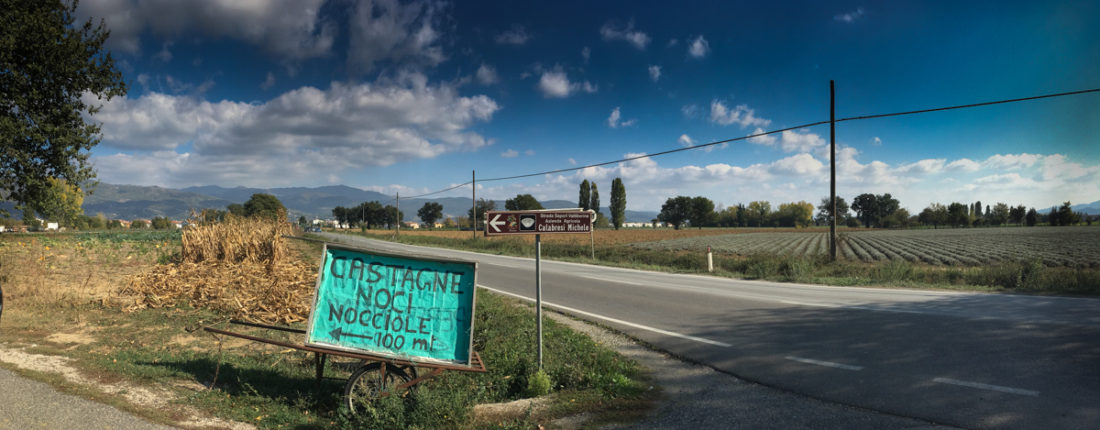
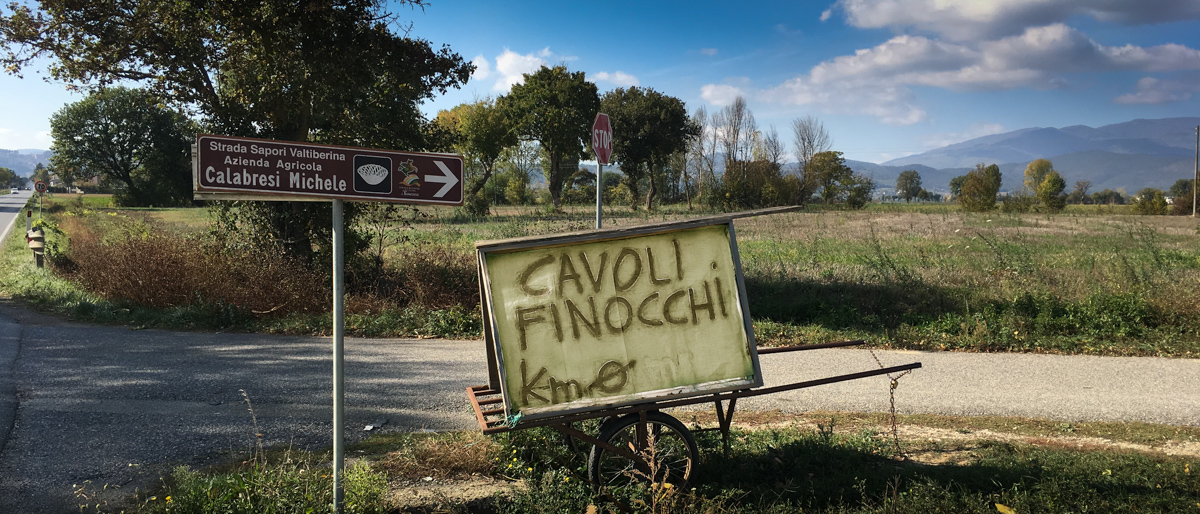
There’s a farm stand I love. It’s a big shed and they sell things from their land, including eggs from the chickens who are underfoot. I asked if they had any broccoli rabe and they sent their son into the field to cut some. He returned with an armful, stems dripping.

They have created a fabulous font.

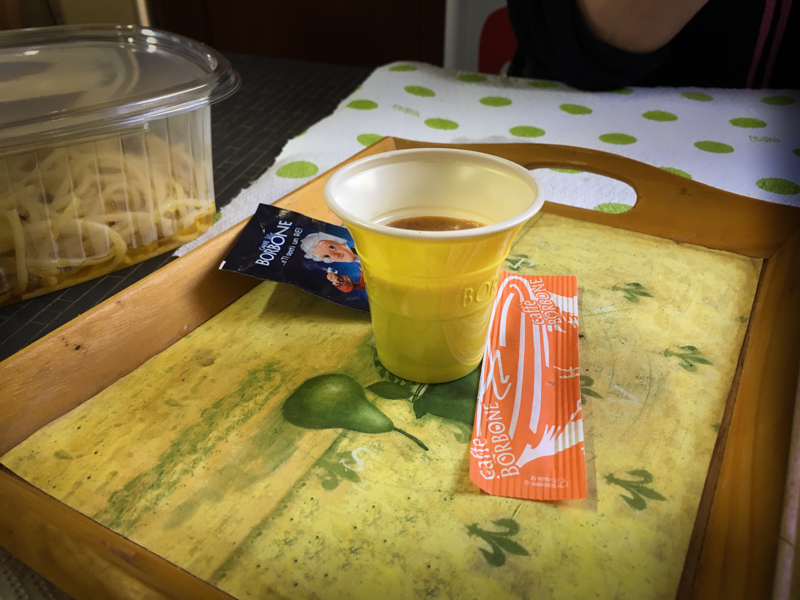
John and I happened to be there around lunch time and I noticed two construction workers sitting at the one tiny table in the place. Minutes later I saw two bowls of spaghetti aglio e olio go by, one of my favorite things to eat. I asked a crazy question—”do you serve lunch here?” The answer was yes, cooked in their kitchen next door. The workers finished eating, explaining that they come here nearly every day, and left the table so that we could sit down, taking their coffee elsewhere.

And we had this wickedly good lunch—grilled vegetables from the garden followed by pasta, and wine. Served with such pride and pleasure. All for €9 each.

My 15-minute errand turned into a 90-minute lunch, making me late for everything else that day, but sometimes when Tuscany grabs you by the collar you can’t say no.

0
0

Are roosters born evil or do they learn?

I never knew that roosters had to learn how to crow. Or that adolescent ones crow an octave higher than the more seasoned members of the flock. Or that they have to learn how to enunciate the whole of cockaa-doodle-doo. These things take practice. Loads and loads of practice as we have learned waking up every morning for the last month.

So it seemed a rooster recording update was needed. Here’s the latest of what we wake up to, as recorded by me, this morning, stomping through our wild boar-ravaged lower pasture, to get to the neighbor’s chicken coop. Couldn’t get close enough because of the wild blackberries to get a decent photo, but will work on it.

0
0

Finding chestnuts. Bravery. And humanity.

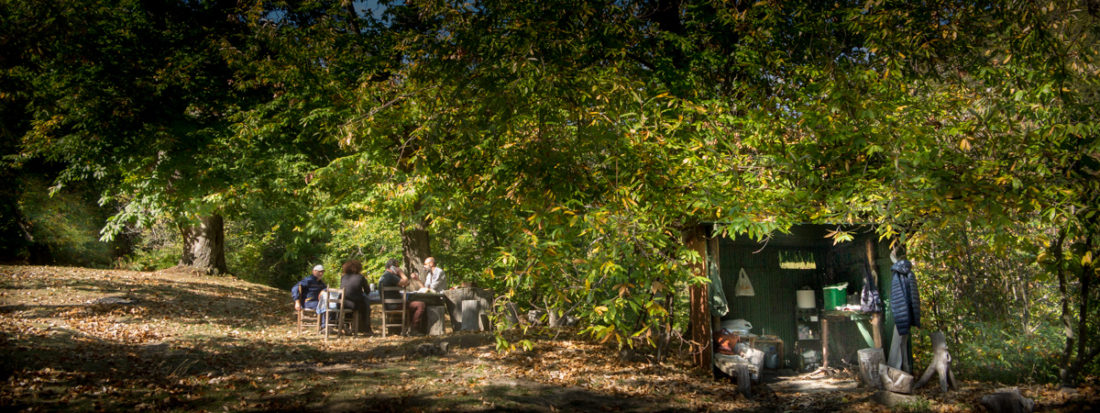
I had this article about chestnuts completely written. Some very nice discoveries that I thought you would find interesting. Then I decided on Friday that I needed to double check a couple of things, and to get some video of the almost-worthy-of-an-amusement park four-wheel drive up a stream bed to get to my friend’s grove of chestnuts in the middle of the forest. I asked him if I could tag along the next time he gathered chestnuts, he agreed, then mentioned that it was his birthday and that a few other friends were coming to have a lunch in the woods.

Simple, right? These things sound so much easier in retrospect, and in print, then they are for me to do. I’m shy, I hate to impose, and am very sensitive that I can’t communicate in Italian with any measure of fluidity or nuance. My Italian is very much in the sledge hammer stage, and I knew I’d be in for an all-day Italian-speaking extravaganza. My heart was pounding with anxiety when I joined friends in the piazza to drive up the hill.

Chestnut Grove from Itch.world on Vimeo.

I also know that this is why I am doing Itch. Every week I am pushed to do more than I am comfortable with, more than I actually want to do, both in my Italian community, and in my creative life. I am creative, every day, for clients, but this is different. This is for me—I’ve never written, at all, before now. But have wanted to, my whole life. Every week is a new frontier, rough edges all around.

And my relationships in the village had reached a comfortable point. I now know hundreds of people, engage in short conversations, goodwill flowing in both directions, but it’s difficult for me to get deeper, for all the reasons above. Itch is a wonderful forcing mechanism.

So I found myself in the middle of the woods, at a long table surrounded by stumps, eating roasted pig parts rejected by the rest of the world but revered by the “real” Tuscans, debating whether truffles found locally actually count as authentic Tuscan food, and singing, yes, singing, helping friends learn the English words to “Knocking on Heaven’s Door” while a guitar was played. And with these sweet, kind, generous, secure, happy people it didn’t matter a bit if my conditional tenses are garbage, or that business development is taking longer than I would like, or that I didn’t know these people profoundly. I was at peace—accepted, included, encouraged, supported. At that moment on a Friday afternoon it was hard to imagine a similar scene unfolding anywhere else but this Tuscan woods. And I knew that this was the point of this post.

Here’s the original article about chestnuts, for your edification.

0
0

La Bella Figura

Itch is delighted to feature more from our Italian abroad, Gianna della Valle, with ideas about how to live more like an Italian no matter where you are. She has made a study of how to bring elements of the Italian way of life into her adopted, more frenetic homeland.


“Far bella figura,” or “make a beautiful figure,” is an Italian state of mind—and a national obsession. “Make a good impression” does not even come close to describing the rich combination of looks, gait, elegance, and manners included in the concept of the “bella figura.”

It means to dress elegantly and appropriately.

It means to have an elegant posture and gait.

It means to smash the objective you’ve set, whatever that is.

It means to stand out with your thinking.

It means making sure the light shines on you, no matter what.

It means taking centre stage and being the main character of the occasion.

It means to be the best at what you do.

It means people look at you and think “wow.”

It means to walk with your head tall.

It means to stand in tunica bianca (in a white tunic) despite adverse situations.

It means losing with class and without losing dignity.

It’s the full package, not divided into chunks with post-industrial taste: philosophy, fashion, interesting lives in social media, right ambition at work.

It’s the “sum being bigger than the parts,” a definition of “homo” with Renaissance smack.

It means to be able to navigate different circles successfully, of being able to be relevant amongst bakers and fishermen as well as millionaires and princes.

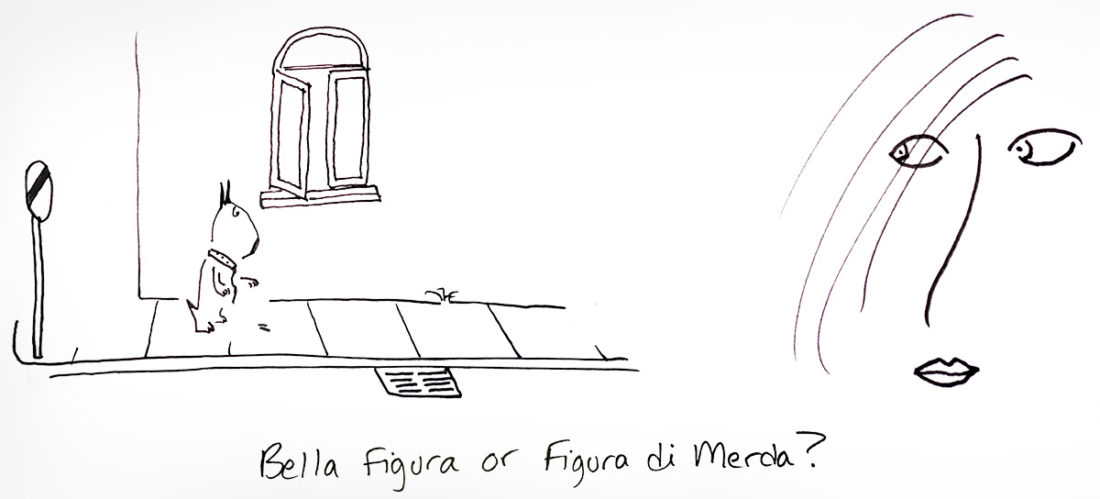
After something happens, parents question their children, bosses their employees, friends question friends: “hai fatto bella figura?” “Did you make a bella figura?

One often hears disheartened accounts of having made a “figura di merda” or “shit impression” with all the details of what went wrong, like a post football match replay after a loss. I remember in high school we even had a nasty jingle to highlight “figura di merda,” clearly a social deterrent for not having prepared well enough.

So dear fellows, companions on this journey on earth, and kind readers: stand tall, head high, put on your best face, and coolest trainers. Today make a wonderful, magnificent, victorious “bella figura.”

0
0

Con Calma

One of my favorite Italian expressions is “con calma,” or “calmly.” I hear it used several times every day.

The phrase is very different from “calm down” in English, which, to me, has this slightly judgmental, and even a bit condescending quality, that hints that you are overreacting. The effect is to make me feel less calm. By a lot.

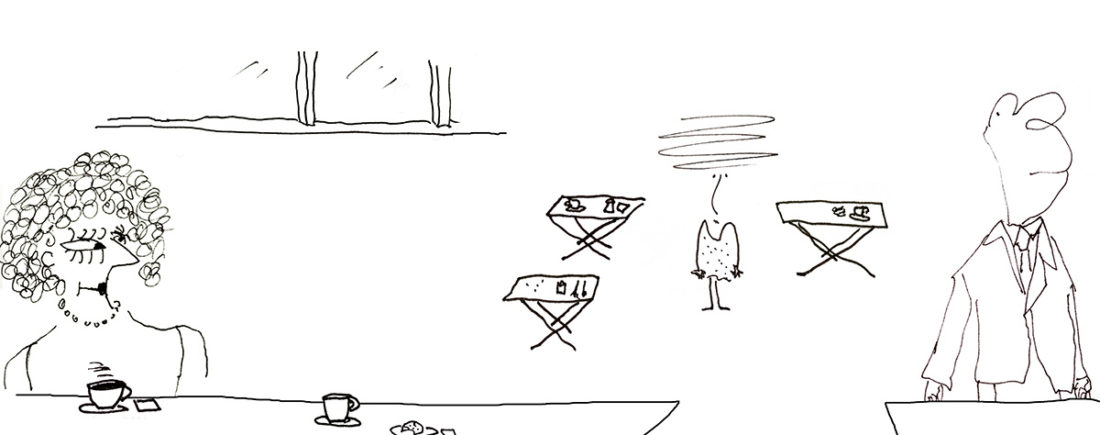
A perfect example of “con calma” was a morning when I was at a cafe near the beach on a small island. There was a big crowd of hungry people waiting for their morning coffee and pastries, and only one woman working—her two co-workers hadn’t come into work that day. The waiting crowd kept telling her “con calma.” With calm. Meaning we get it, you are doing the best you can, it will all work out, breathe.

There’s a local restaurant that we love that serves squares of pizza from big sheets and little else. There’s the wife who serves and works the register, and the husband who cooks in the back. The two could win the Olympic gold in pairs for “con calma.” It’s always a comforting and calm experience eating there, even on Wednesday lunch during the school year.

Wednesday is the long day at the town’s public schools, so the kids don’t get out in time to go home for lunch. The elementary school has a hot lunch provided, complete with three courses, china plates, and actual flatware. Served by volunteer grandparents at long tables. But there’s no school lunch available for the middle school students, and people seem to fear that they might go hungry, or have to eat something cold, in which case the world might end. So parents have organized this thing where a couple of them go to this restaurant with all the kids’ requests for pizza—all custom made and assembled into labeled bags—which the volunteer parents then deliver back to the school a couple of hundred yards away.

The restaurant comes to a standstill for other patrons, who all stand around waiting for about 45 minutes while the staff of two completely focus on each order for the kids. “Paolo gets one slice of salami pizza and one hot dog pizza, a bag of chips, and a Fanta.” Times about 30. It’s town “con calma” in action for all concerned—the relaxed and understanding patrons, the husband and wife team, and the parents who make it all possible. No one is flustered or annoyed. After all, in Italy, everything stops to make sure that kids eat well.

I can’t think of an equivalent phrase in the U.S.—maybe because being calm, an acceptance that others are human, that situations come up, and, as a result, things might not move as quickly as we’d like—aren’t things we particularly value or want to accept.

As I go through my day and am stressed about little things I frequently tell myself “con calma” and it reminds me to save the stress for things that really deserve it.

1
0

Living like an Italian lion—in London

Itch is delighted to feature the second installment from our Italian abroad, Gianna della Valle, with ideas about how to live more like an Italian no matter where you are. She has made a study of how to bring elements of the Italian way of life into her adopted, more frenetic homeland.


I read that lions, most of the time, take it very easy. These prolonged periods of laziness are the foundation for big bursts of energy spent hunting prey (or mating)—in short getting in the swing of things only when it really matters. The rest of the time they enjoy the moment in the slow lane.

Italians aspire to live in the slow lane, punctuated by bursts of intense activity only when required, or when emotions demand.

Despite more than 20 years abroad, I am no exception. I like to start my day in London as I would in Italy. The other commuters rush to the fast train to get to work as quickly as possible. Not me. I figure I will be hunting all day in my office. Now it’s time to enjoy.

So I choose a nice path to walk to the station and catch a very slow and uncrowded train. Sometimes I stop at the local station cafe for a coffee. Other times I meet my grown-up daughter at the main station at the nicest breakfast place. We sit there and pretend to be in Sardinia at Capo d’Orso, having breakfast while listening to the sound of a harp on a terrace overlooking the Mediterranean under olive trees. We ponder the finer point of life while we sip our organic smoothies or eat our avocado on toast. We talk, we laugh, we people watch. We are the lions on the savanna. Gazelles run all the time: they have to. Lions, however, lounge majestically.

And then the clock reminds us that it is time to go to the office to hunt. I have never figured out, though, if in my office-savanna I am a lion or a gazelle. Most likely a gazelle, aspiring to be a lion.

0
0

My pasta aisle is bigger than yours

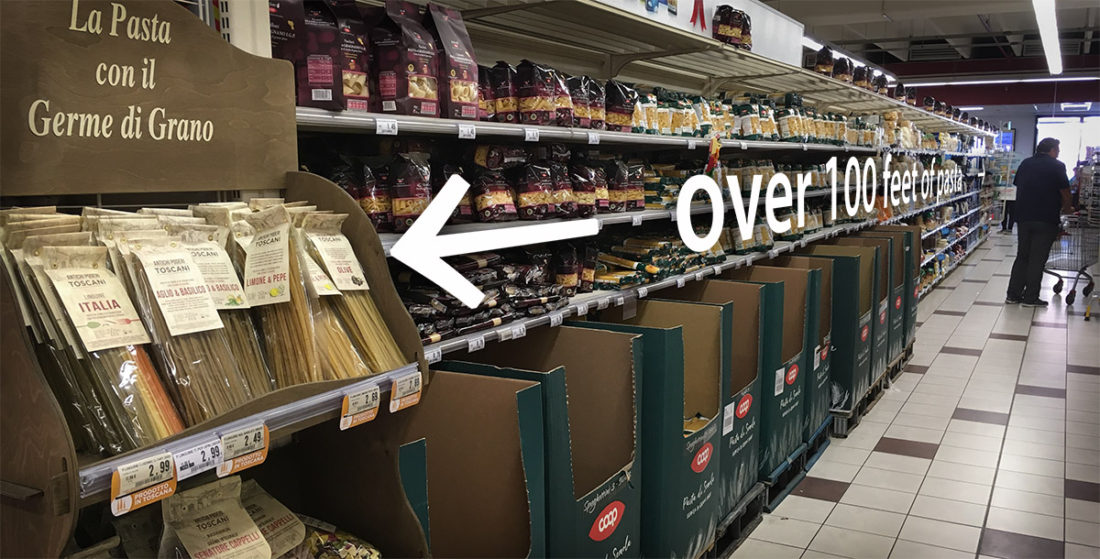
Dear readers, I have decided that you do not, yet, know enough about pasta. I have started to accept as normal that there’s a pasta aisle bigger than Texas in every Italian grocery store.

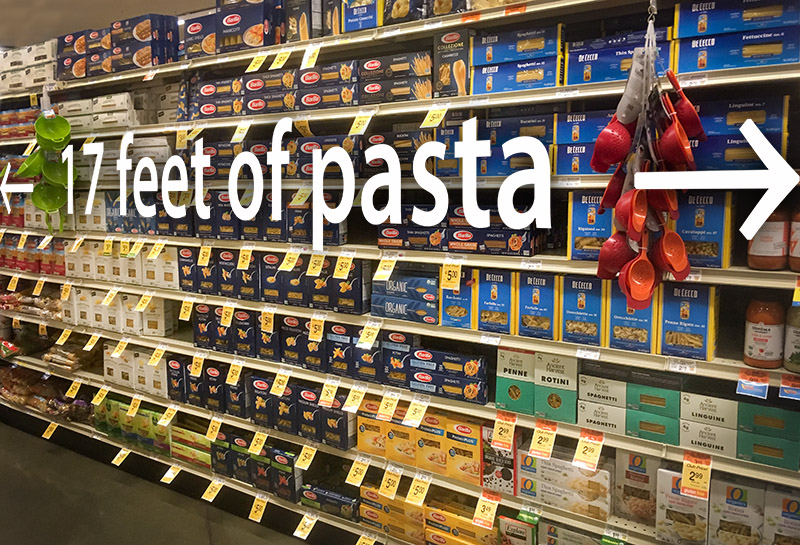
On a recent trip back to California we were stunned to rediscover that the pasta section in Safeway was a mere 17 feet. Felt like trying to find provisions for a fine meal in a 7-eleven.

So I will begin to educate you. You need to be able to tell your frogs’ mouths pasta from your radiators and volcanoes. You need to know that al dente is far more crunchy than what you probably think. What sauces go with what shapes. That the cooking water needs to be salted far more than you probably do now.

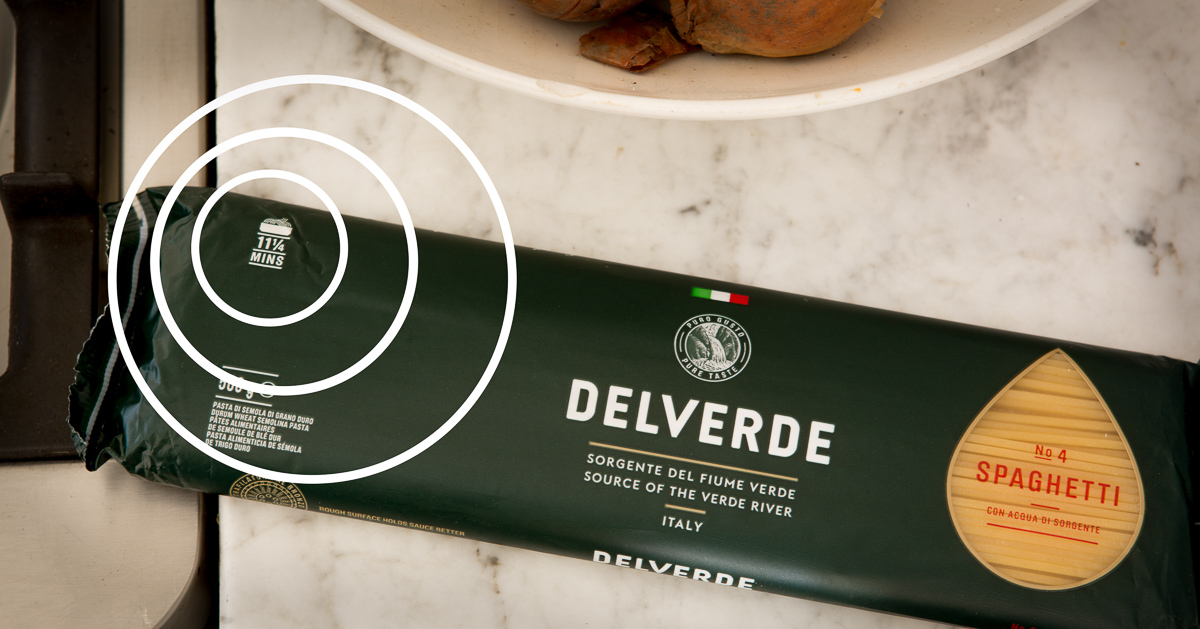
And you need to know that you never have to do anything as uncontrolled as throwing pasta against a wall to test if your spaghetti is done. Italian cooking is far more scientific and precise than that. The know-all cooking times on the packaging need to be taken very seriously.

This spaghetti, for instance, is perfectly cooked at 11 1/4 minutes.

(Unless you finish cooking it in the pan, like spaghetti aglio e olio, when the spaghetti is removed two minutes early to finish in the pan with the garlic and oil, and a couple ladles of the pasta cooking water.)

Full disclosure—I don’t yet know everything about pasta. This is an excellent excuse for me to up my pasta game, and keep you informed of the discoveries.


0
0

Making gnocchi, and a film, in Italy

John and I have this idea to start filming local grandmothers cooking. A possible way to enter more deeply into Italian life, capture some of the spirit of Tuscan woman, and learn more about food.

We gather some savvy, younger locals and start brainstorming about people we can shoot. The grandmother who hunts? Possible. The grandmother who makes feather whips for the lingerie store? Very possible. For our first shoot we settle on two of our collaborators’ grandmother in a house in the countryside outside of town, complete with a huge watermelon patch.

The morning of the shoot comes. We are prepared to act with military precision, which is the norm for any shoot. The “call time” comes to meet our collaborators and head to the country. The meeting location changes. The start is delayed because breakfast isn’t finished. Their grandmother actually lives in the ancient center of town, not near the watermelon patch at all. We start to get nervous.

We arrive at their house on a tiny street from the 1100s and the grandfather, Franco, jumps into cooking action. Maybe the premise of the video, cooking grandmothers, needs to be reassessed?

Then it all starts to unfold. The constant lesson of Italy. You can predict nothing, control nothing, but just step back and enjoy the gifts of grace, ease, and warmth that the Italians offer. Which more often than not is so much more than you could have possibly imagined or engineered.

Anna, the grandmother, is everywhere in the kitchen at once. This gnocchi pas de deux has clearly happened hundreds of times in their kitchen. Both of them are cooking with a rare ease, barely even looking at the food as they cook.

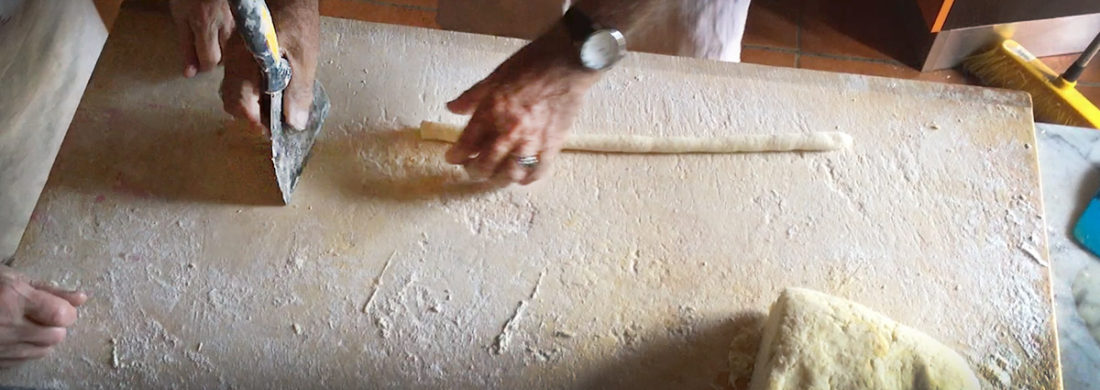
While Franco forms the dough for the gnocchi, and then shapes and cuts it, he tells us stories about what is was like for families growing up as tenant-farmers in the years before the “economic miracle” of the 1960s (thanks Marshall Plan), with 30 people in a house, hunger, limited mobility, and the Padrone with total power.

The conversation ranges across centuries and topics, and the enormous mound of gnocchi dough melts away. Anna is taking away the cut gnocchi, boiling it, and then rolling it in oil to separate and cool, directly on the marble table.

Soon after we sit down with the extended family to eat. As it has been said before, “And it was good.”

This is, in some ways, one of the most unfiltered films we’ve ever done. It’s as close as we can get you to sitting down in a Tuscan kitchen for a visit. Please let us know what you think of this rawer kind of glimpse. And we hope you learn a lot about gnocchi along the way.

0
0