


Meanwhile at lunch…
I’ve just returned from a week in Paris followed by two in California and while my mind has been occupied by strikes and sales in Paris and traffic and tension in the Bay Area I kept remembering a few tidbits of news I wanted to share with you from the homefront.
Expansion at the farm stand
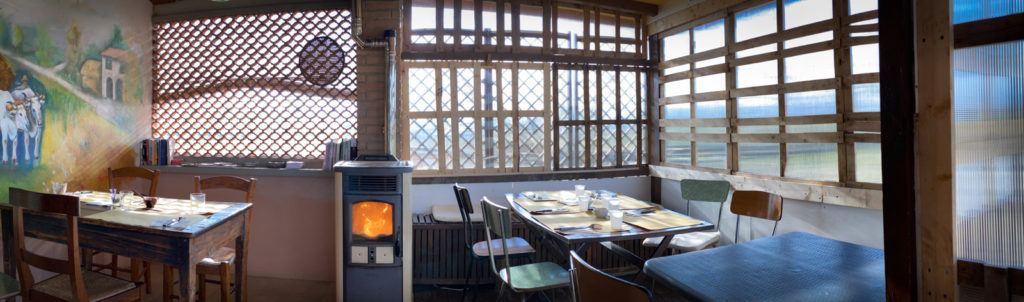
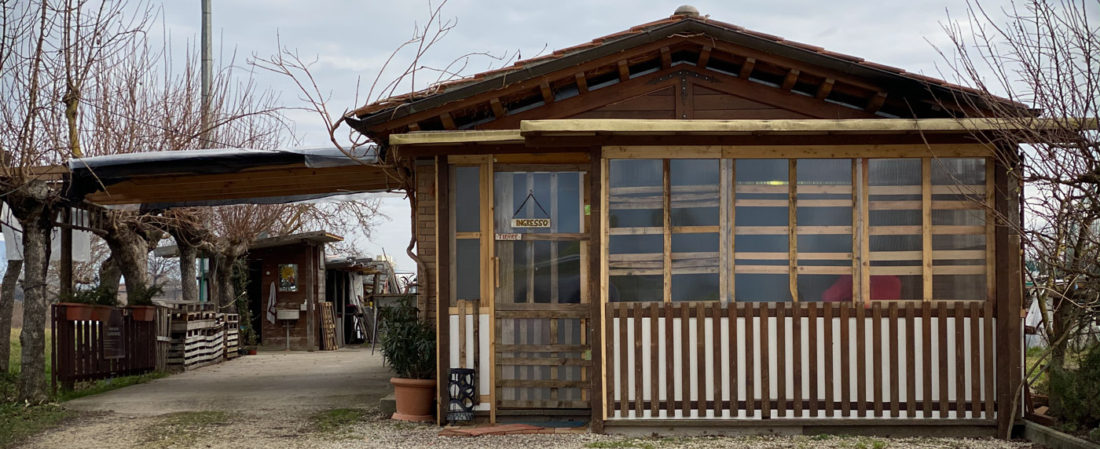
The farm stand, which serves a 10€ mostly vegetarian worker’s lunch made from their produce, always faces a significant issue when colder weather comes. Their unenclosed front porch, which holds four tables in addition to the two that fit inside, becomes much too cold to use and significantly decreases the number of lunches they can serve. But this year Michele solved it. I arrived one day to find him beaming with a decided spark in his eye putting the finishing touches on the porch enclosure, thanks to wood provided by produce crates, a few sheets of plastic, and a nail gun. This infrastructure, boosted by two pellet heaters, has done the trick and now they can operate at the full number of “tops” year round. I assume that the removal process to return it to an open porch come summer will not be too difficult as the installation took an afternoon.
The pig is no longer with us
Colder weather brings the spezzatura or dismantling of the pig. We were lucky enough to be invited to join a family for their annual event last year which was one of the most fascinating and completely Italian things I’ve done since moving here. The respect, care, and attention given to preparing a year’s worth of meat from an animal everyone knew moved me. A couple of days before I left the farm stand had killed their pig and completed the spezzatura. To celebrate Michele said they were preparing a very special lunch later in the week — freshly-made sausages and chestnut polenta — and asked if we wanted to come. I love the local fresh chestnuts (yes frequently roasted over open fires) but have a hearty suspicion of other chestnut-based delights. For many Tuscans if you combine chestnut flour with water, olive oil, rosemary, and pine nuts and bake the whole mess it is suddenly a revered dessert, castagnaccio. Unfortunately it looks just like a brownie. Do not make this mistake as I have.
Anyway, Michele was especially excited about the chestnut polenta. Silvia, standing behind him, mouthed that she was also going to make “something good”. With great reluctance John and I showed up the day of the feast and bravely opted for one order of the sausage and chestnut polenta. (We also got one order of the “something good” to cover our bases.)
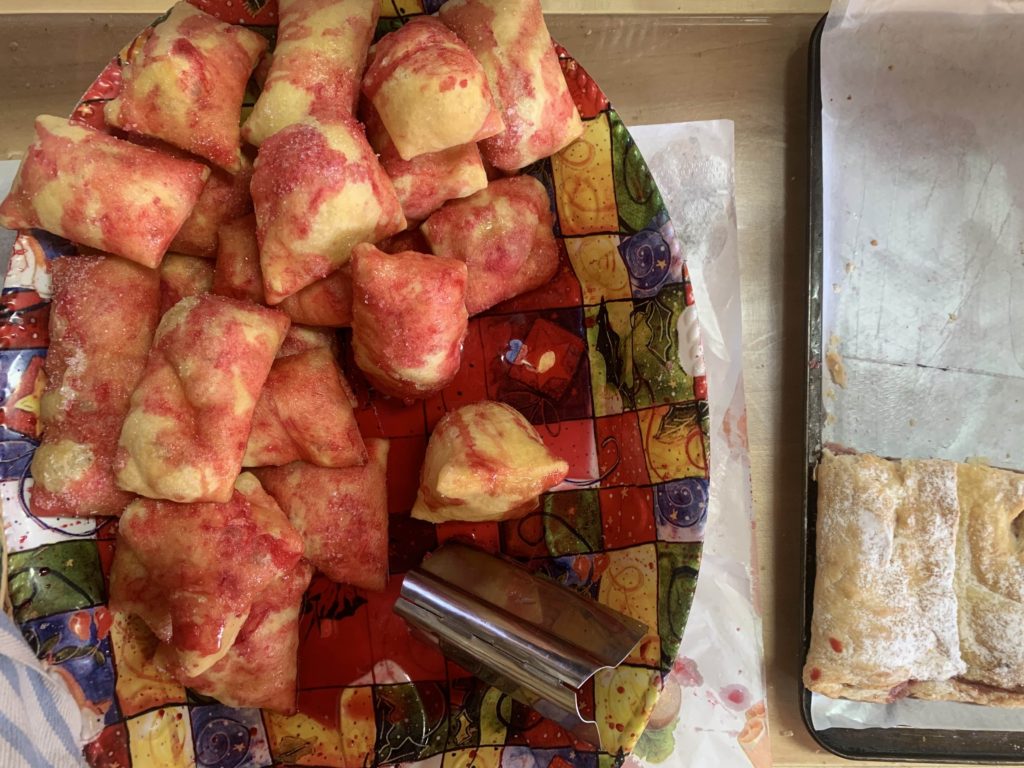
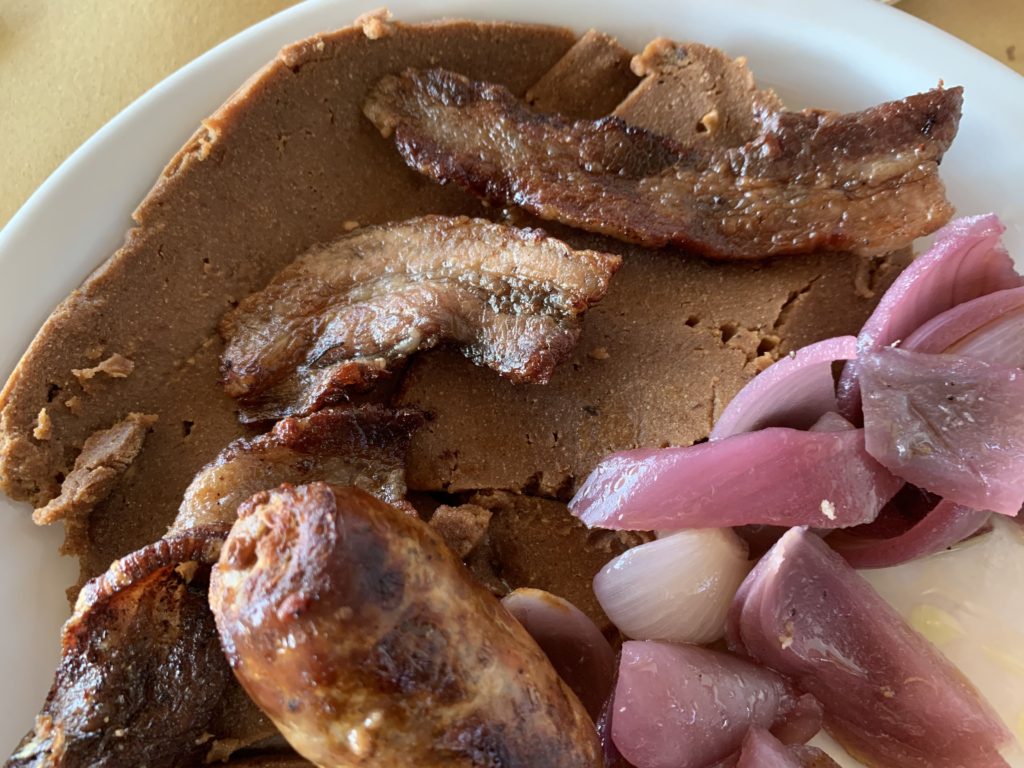 The sausage and pancetta from the pig were delicious, as were the onions. The chestnut polenta was not as bad as expected, much better than the castagnaccio dessert, even though it had a strong resemblance to Play Dough gone wrong. But I did not opt for the sweet version of the chestnut polenta, served with ricotta, for dessert. Instead I ordered the classic ramp up to carnevale and Lent Tuscan dessert, castagnole, which are bits of dough that are fried and around here often stained with runny dark red sugar (Christ’s blood?).
Royal Fascination
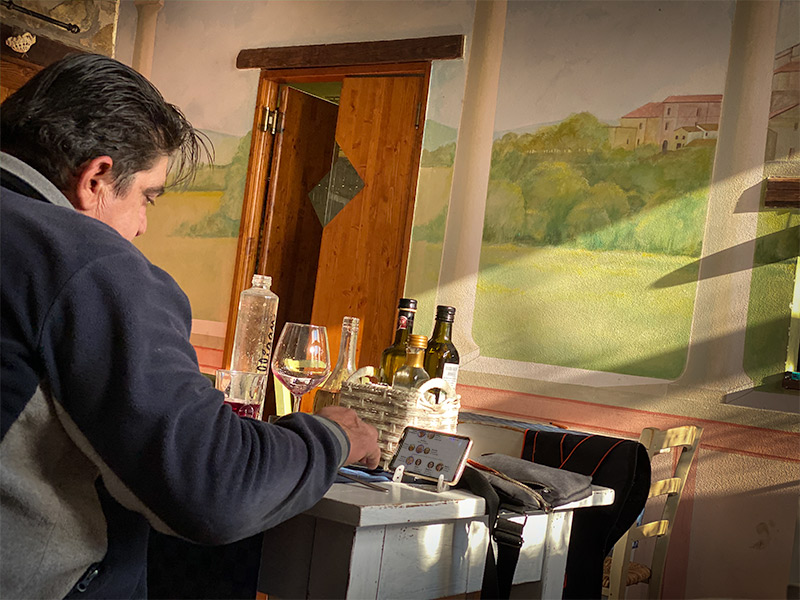
John and I happened to be having lunch at another local favorite while the emergency meeting was going on between the Queen, Prince Charles, and Prince William about how they were going to handle Megxit. I didn’t know this because I was following with rapt attention but because the large man with work overalls at the next table was. Propped up amidst his quarter litre of wine and pasta was his phone, loudly streaming the live coverage from the U.K. as the swarm of reporters waited on any news of the outcome of the meeting.
God save the Queen. And lunch.
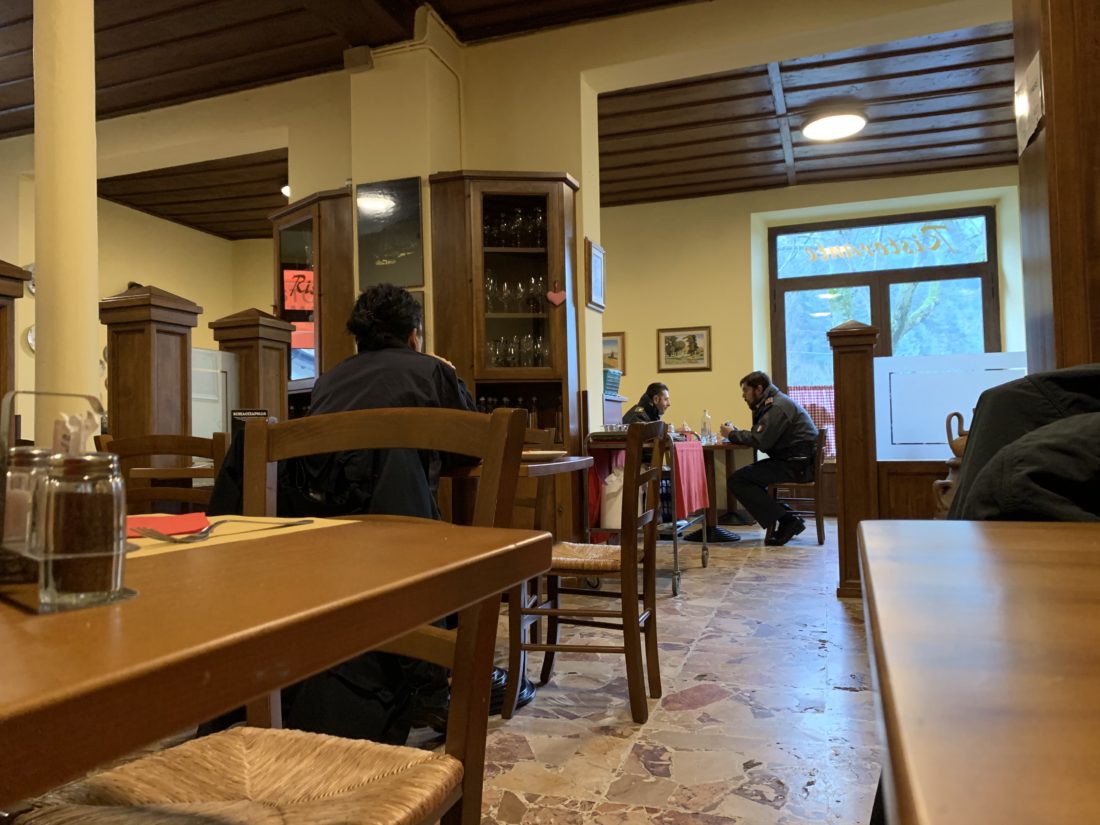
Postcard from a lunch in the woods
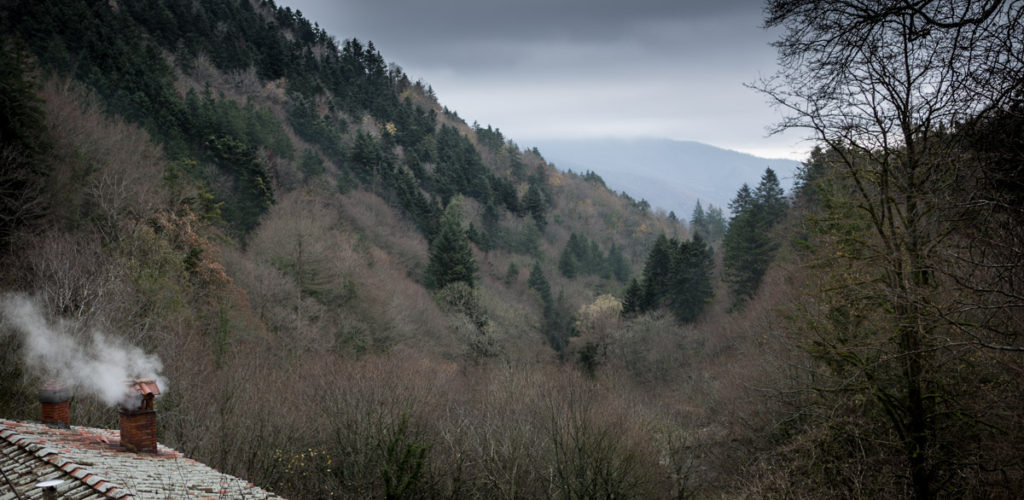
I’m at the Antica Farmacia dei Monaci Camaldolesi and it is lunchtime and I am hungry. I have just driven through miles of lonely, misty forest to get to the monastery and I’m surprised to see a restaurant opposite that’s open. I cross a little bridge over a rushing stream in a gorge in the forest and go in. I am the only person there and am shown to a table near a small wood burning stove.
The menu features lots of wild boar, freshly made focaccia, and sausages cooked over a fire. I order and another woman comes in wearing a forestry uniform and packing a gun. The owner follows her to the table carrying a large, freshly peeled carrot on a plate and puts in in front of her as soon as she sits. She quickly eats the carrot. The owner than asks her how the health routine is going and if she’d like her usual salad for lunch. With cheese. And her usual quarter litre of white wine. She agrees.
Two men enter, both dressed in a similar uniform, and also carrying guns. They look over at the woman, and she looks back at them, and the most restrained greeting I’ve ever seen in Italy is exchanged. They are then seated at the other side of the otherwise empty restaurant.
She leaves soon after. I wonder what the real story is. I think of how lonely it would be to work with people in the middle of nowhere that you wouldn’t want to have lunch with.
Holiday gift inspirations from Italy: Busatti
The love affair started started when Sebastian, then age eight, shot his Nerf gun through a window at a bride-to-be preparing for her wedding day. He managed to hit Anna-Sophie in the head with a foam bullet while she was doing her hair and got one of the best dirty looks in history. The first meeting was not promising.
We had moved to Tuscany that day and into a house in the countryside for a few weeks, so that the kids could start school, until our ten-month rental in town became available.
It was the same day that the son of the family who rented us the house, Livio, was marrying a lovely woman from Germany, Anna-Sophie, who was staying with her family in the house next door. The groom’s father explained away the Nerf incident by attributing it to the DNA of my husband, John, who he believed to be a part of the US Special Forces (for those who know John this is laughable) rather than the barbaric nature of eight-year old boys. How this very funny case of mistaken identity occurred we are still not sure even seven years later.
Despite the first encounter we all became fast friends and Anna-Sophie agreed to show Sebastian the Italian ropes for the first year or so, a curriculum much helped by liberal applications of Coca Cola, almost daily lunches with the extended family, and Angry Birds games every day after school at the local cafe during “study” sessions.
It didn’t take long for me to realize that Livio is the sixth generation of a family who makes some of the highest quality, and best designed textiles in the world, called Busatti. They have stores worldwide, and are represented in high-end stores (dog whistle here) like ABC, Aero Studios, and John Derian in New York, Diptyque in Paris, Sue Fisher King in San Francisco, and Neiman Marcus.
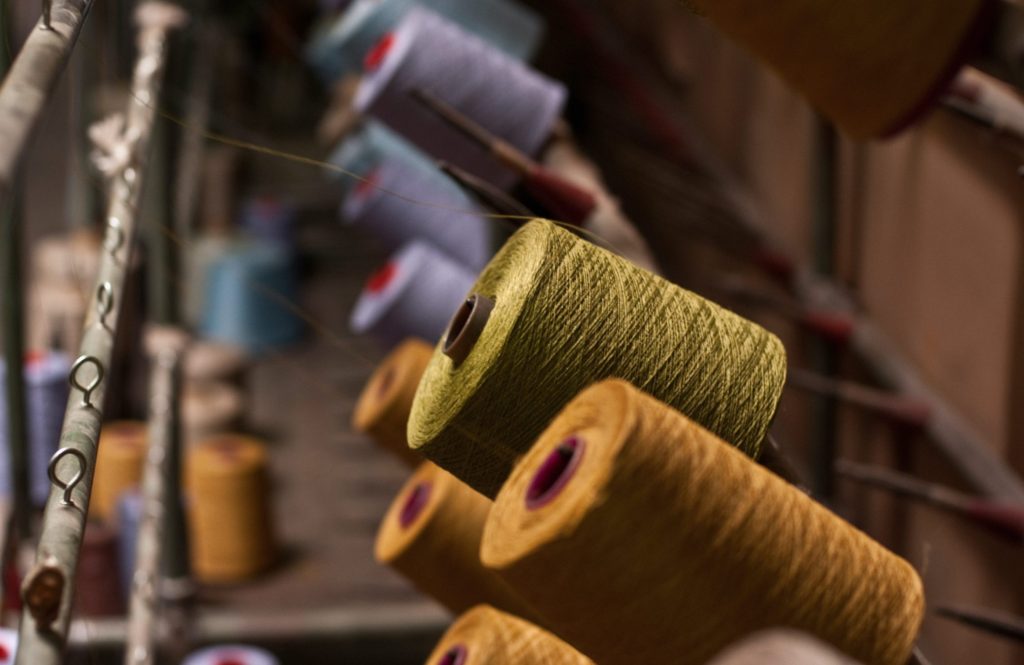
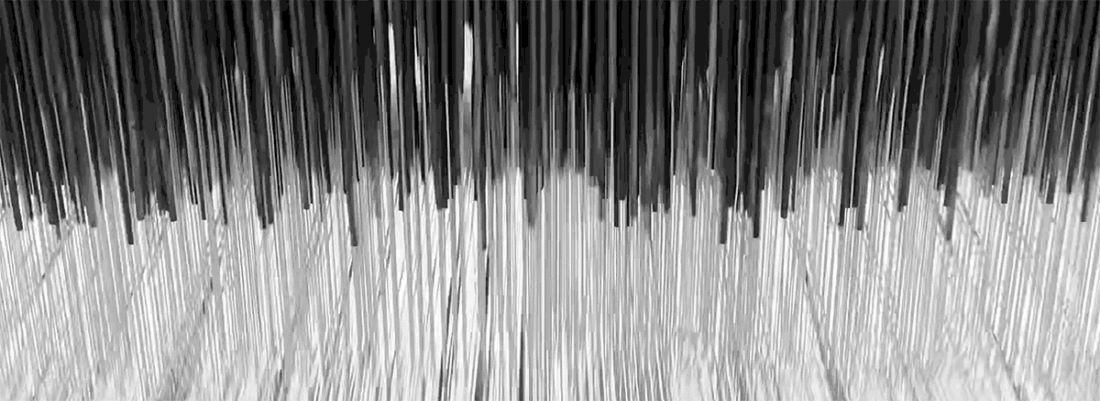
Busatti started (in the same building as the current headquarters) in 1755 as a bit of a catch-all mercantile that shifted to cloth production in 1797 when soldiers from Napoleon’s army moved into the top floors of the store and brought an enormous, steam-driven loom to make wool into uniforms and blankets which was installed in the basement. By 1799 the Busatti family had taken back control of their store and the weaving equipment which the army left behind—it’s massive. The machines still crank away in the basement, although now driven by electricity rather than steam.
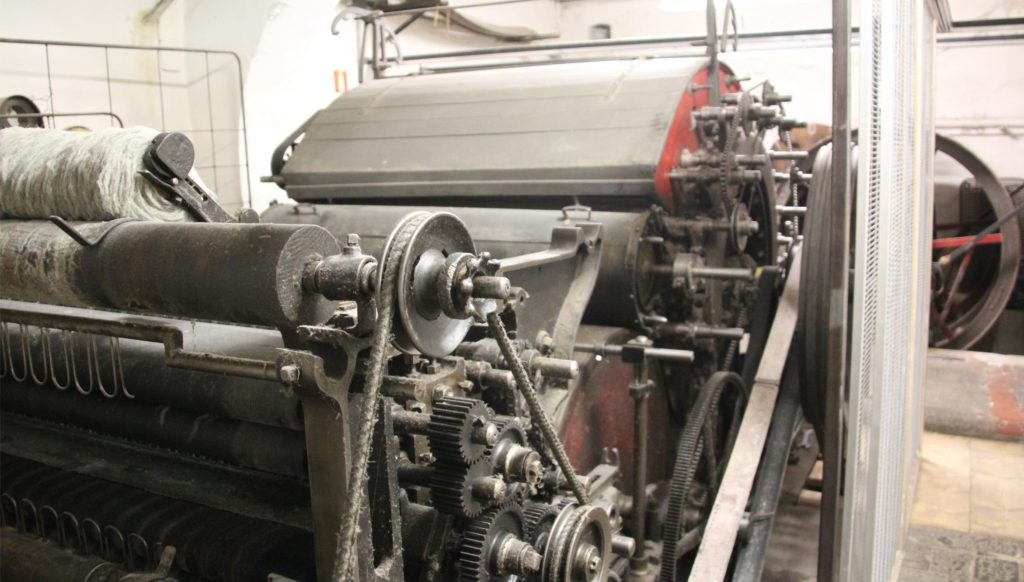
After the equipment sat dormant for several decades Mario Busatti added eight wooden looms, a warping machine, and a staff of ten in 1842 . They’ve been at it ever since.
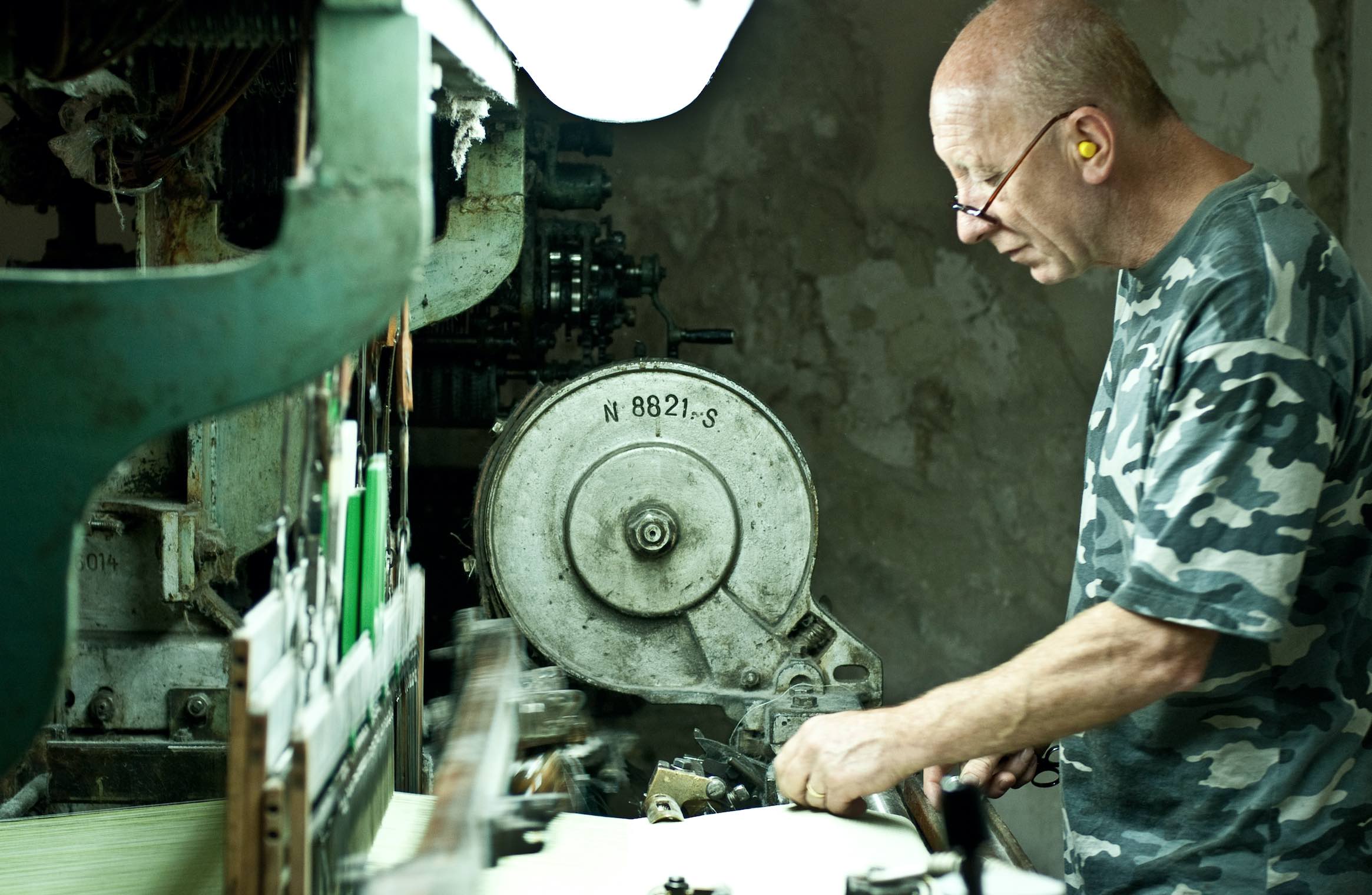
I love that Busatti products are a perfect mix of tradition, still largely produced on punch card driven looms, and innovative designs under the capable leadership of Livio and his brother Stefano. I go in frequently to get seasonal inspiration because there is always something new to see. Plus they will special order anything you can imagine—bedding and table linens to any dimension, color, etc.
But let me cut to the chase. I can recommend some things that would make great gifts and they ship worldwide. Best of all, Anna-Sophie and Livio are giving a special discount of 20% to Itch readers through the holiday season. Make sure to click on this link to get the discount.
Here are my three favorite things from Busatti for gifts—although your discount covers anything on the site.
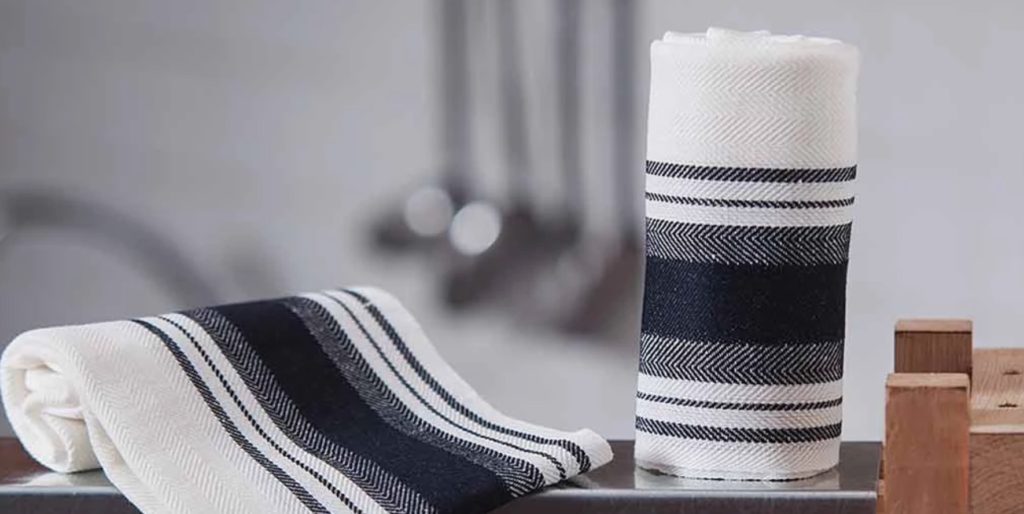
I have many of these wonderful stripey dish/tea towels and they give me pleasure every time I use them.
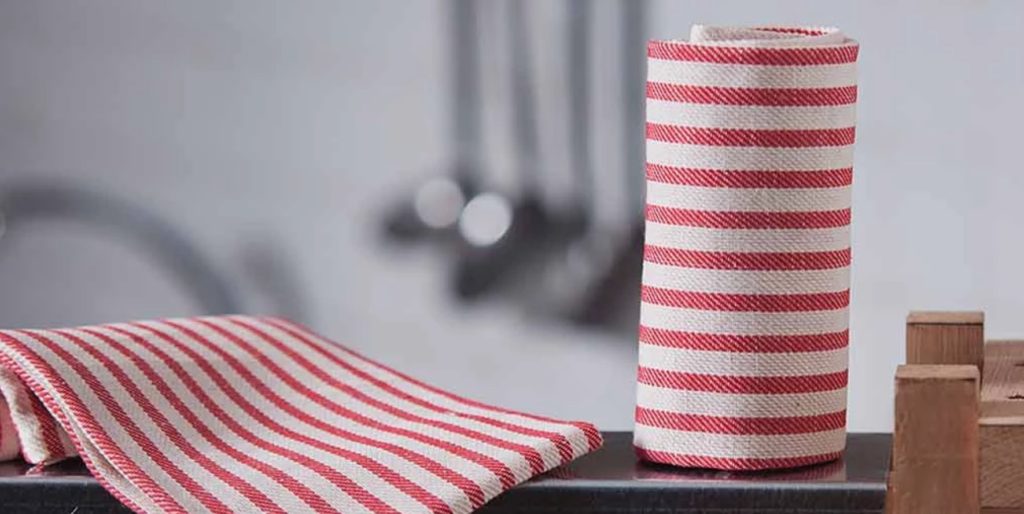
They are 60% linen and 40% cotton, come in a wide range of colors, you can get them plain or with embroidery, and they wash beautifully because they are thread-dyed so they don’t fade. (They call this weave Melograno.) I also love the weave called Due Fragole which also comes in a wide range of beautiful colors.
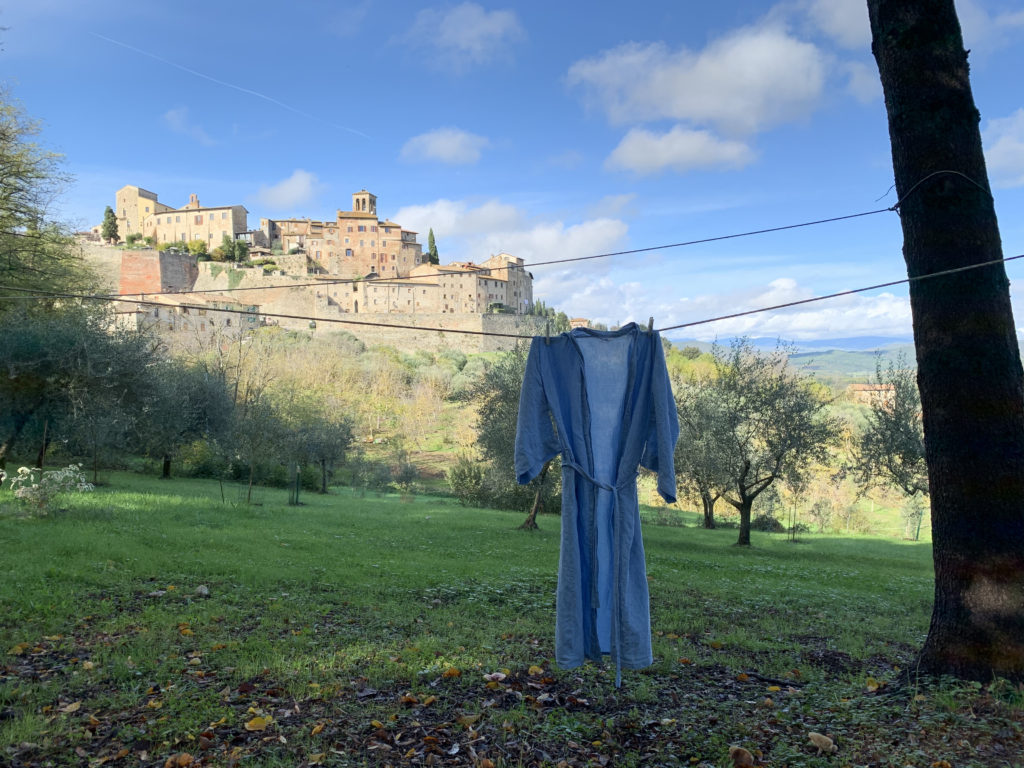
About a year ago I splurged and bought a linen robe which makes me happy every morning. Mine is in this beautiful not-too-light blue and washes well—I line dry and don’t iron and it’s soft and for me, nicely wrinkled.
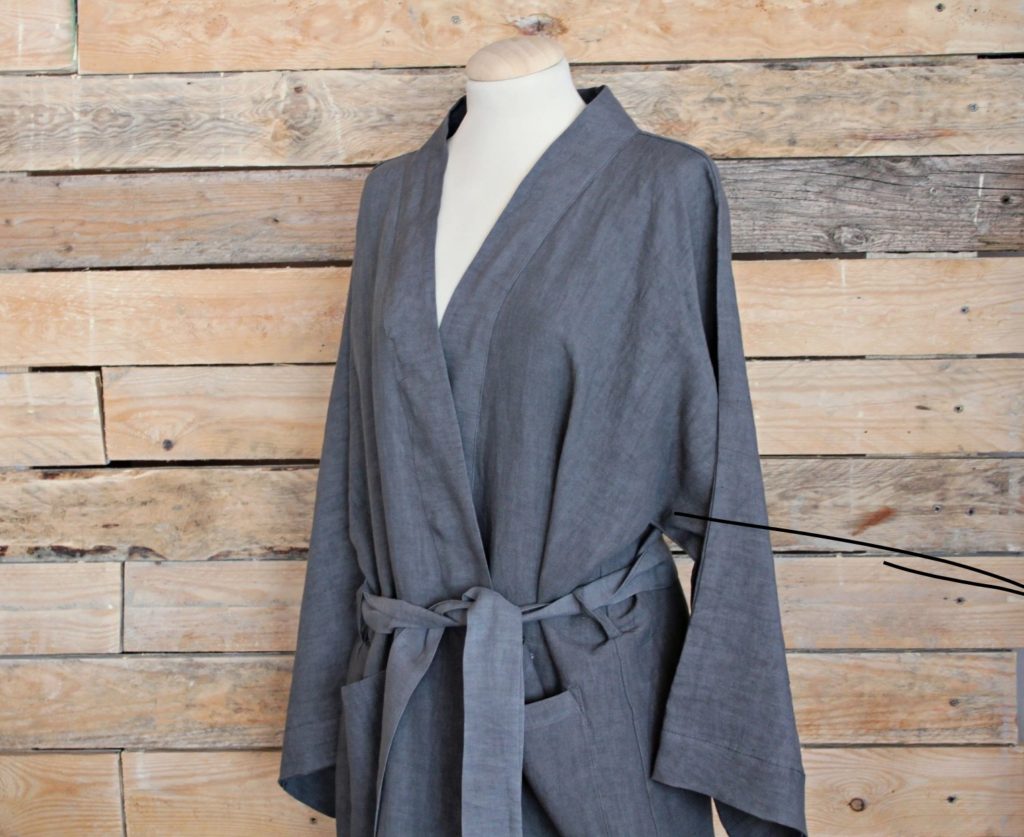
But the slate gray robe is also jaw-dropping to me (and several friends who have succumbed.)
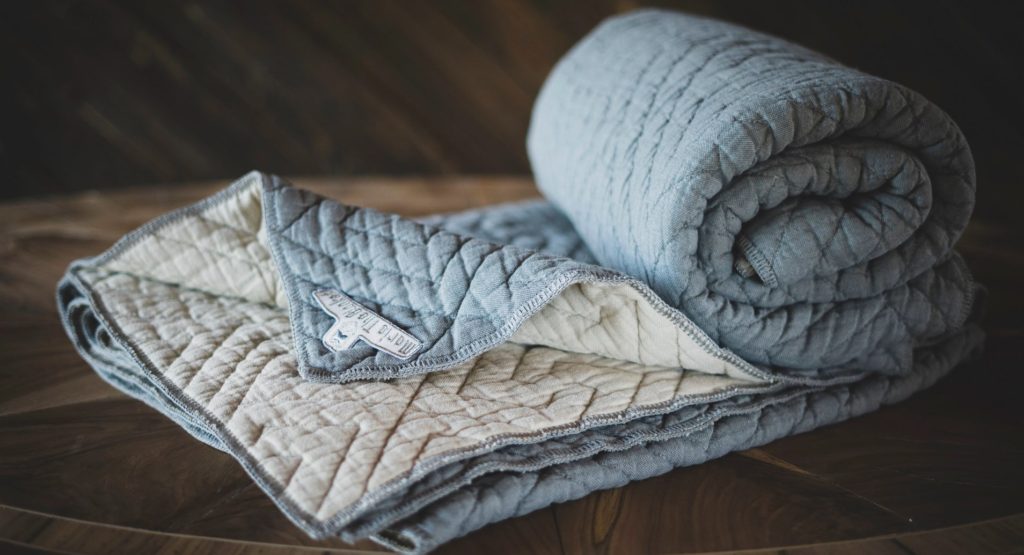
Busatti has just launched Mario the Blanket in honor of Mario Busatti. I haven’t purchased it yet, but really want one. It’s not quite large enough for a bed, but would be fantastic to cuddle up with on a sofa. It’s made of an interesting mix of cotton, wool, and seaweed fibers, which are supposed to have potent antioxidant properties and looks and feels lovely.
To shop, make sure you enter through shop.busatti.com/discount/ITCH20 to get the 20% discount. They ship to the outside Italy using UPS at reasonable rates and you will be supporting a fantastic family business as well as giving a lovely gift.
(Thanks to Busatti for the wonderful photos, which are all their copyright with the exception of the video and wrinkly robe photo, which are mine.)
Happily Ever After
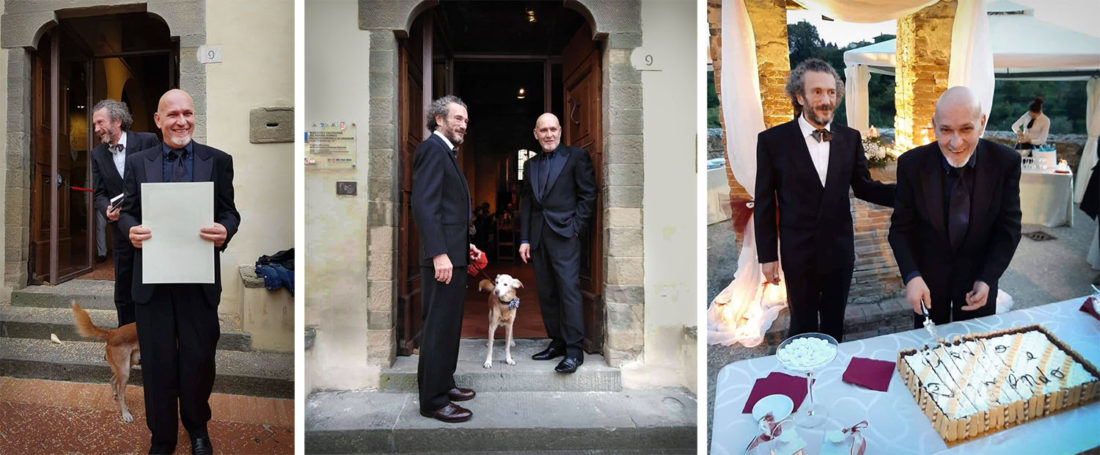
I was very excited to hear the news that Carlo and Armando got married — the first same sex marriage in the 1,000 history of the village. I have been impressed by the support and openness the village has shown the gay couples who have chosen to live here but the majority have been from America or other parts of Europe. Carlo was born and bred here and I wanted to find out how a tiny Tuscan village with a largely older population feels about one of their own taking a less traditional path, so I invited Carlo for a coffee.
When I say born and bred here I am not exaggerating. Carlo actually sleeps in the same bed he was born in, in the same room, in the same house. In his teens and early twenties he dated a girl for about six years but slowly realized that his sexuality was taking him in a different direction. He moved to the US for several years, Rome after that, and also lived in Arezzo, but the whole time life in his village was calling him back. He returned in his 40s to live in the house with his mother and would go out on weekends to clubs that were gay-friendly as far away as Rome or Florence.
One evening eighteen years ago he met Armando and they have been together ever since. He and Armando started spending weekends together as Armando had a cabin the the country and both were living at home at the time. One day Carlo’s mother said “Why are you always packing your bags and going away for the weekend? If you have someone in your life I want to meet her.” Carlo admitted to being deeply in love, but with a man. Without missing a beat his mother said to bring him over for dinner so she could see what kind of a person he was. Carlo still remembers the tension of the evening, but at the end his mother was nearly as in love with Armando as he was.
Armando’s parents both died as all this was going on, and Carlo’s father had died a few years previously, so both decided to move into Carlo’s birth home with his mother. Carlo remembers how close and welcoming his mother was from the start, treating Armando like another son. All of them would even go on vacations together. When she got sick with cancer both of them took care of her during the four-year course of the disease until she passed away.
The official coming out of the couple was equally supported by the village. Carlo said that he never constructed his identity around being gay, but just who he was, loving who he loved. He said that the village treated him the same before and after Armando was on the scene, and Armando was quickly accepted by everyone as being a lovely addition to the community.
Carlo and Armando had talked about getting married for the last few years and finally, rather spur of the moment, decided to do it. (Partially because the political climate here in Italy —as in so many other places — is always on the verge of shifting more extremely to the right and they wanted to take advantage of having this right to marry.) They didn’t send out any formal invitations but there was a notice posted, as for all things official, at the comune, or City Hall. There was a huge outpouring of support and enthusiasm as the word spread and over 100 people came from far and wide to help them celebrate. The outpouring on social media was equally impressive.
After 1,000 years some things were ripe for change. And I can’t imagine a more deserving couple to initiate it.
Halloween in Italy
My Halloween week started with a really disturbing dream involving the reappearance of my Mom who passed away three years ago. I don’t want to go into any details but in my dream she was decidedly, very certainly, unmistakably dead. And I was not pleased to have her visiting me in that state.
I was telling a friend about the dream who it turns out believes that this time of year, exactly around Halloween, is when the veil between the living and the dead is the thinnest, and that this has been known and celebrated around the world since pagan times. The Celtic Druids marked the midway point between the Fall Equinox and the Winter Solstice with their celebration, Samhain, that is an early forebear of Halloween. It coincided (at that time in history) with the Pleiades star cluster culminating at midnight, which is somehow very relevant. The spirits of the dead were thought to be the most restless and present to the living world on this special night and needed to be shepherded back to the land of rest.
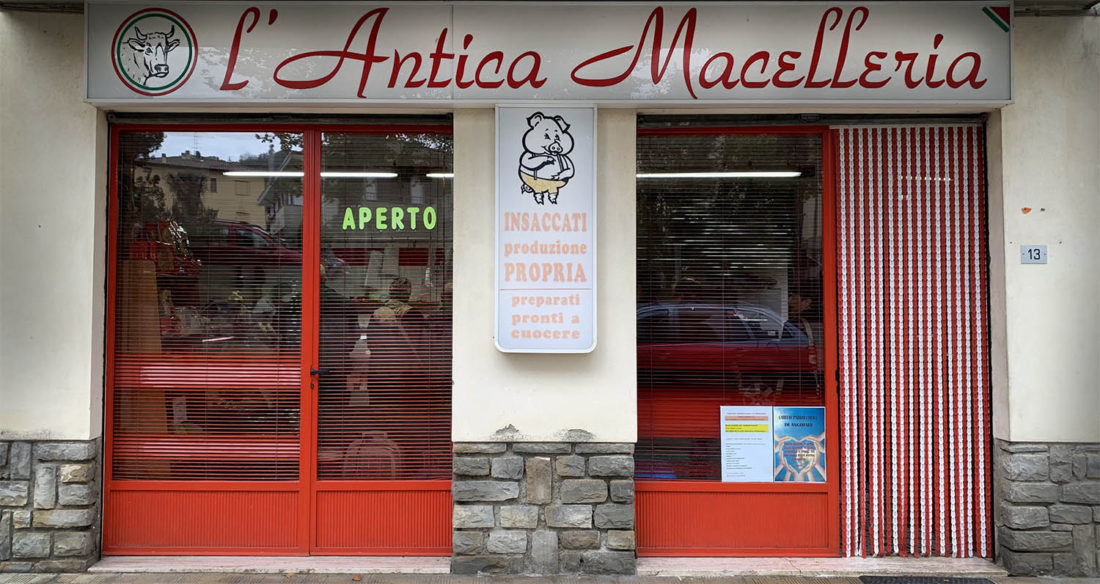
This rumbling in my subconscious caused me to look at Halloween in a different light. I’ve always heard about Day of the Dead celebrations but before moving to Italy had never lived in a culture where this aspect accompanies, and overshadows, Halloween. When we first arrived seven years ago Halloween was barely a blip on the local scene. I was really worried that Sebastian would nix our move as this was the first holiday he’d celebrate in Italy, so his then eight-year old self and I dressed up in some pieced-together costumes, me carrying an arsenal of nerf-guns and armed with a supply of American Halloween candy, and set out in the mist to the deserted square to trick or treat. We were told to stick to the stores. Most shopkeepers were mystified about what we were up to but glad to receive a dolcetto Americano, an exotic treat called a miniature Snickers bar, in a kind of reverse exchange. All good-naturedly contributed something. Our favorite “treat” was a sausage from the butcher. I will never forget Sebastian’s face when the butcher handed it to him over the counter.
Much has changed in seven years. Now you commonly see carved pumpkins, there are a few activities for kids, and there’s a general festive atmosphere in towns and villages. The next major town has a Halloween disco. The grocery store features a small selection of kids’ costumes. But it’s not the big event.
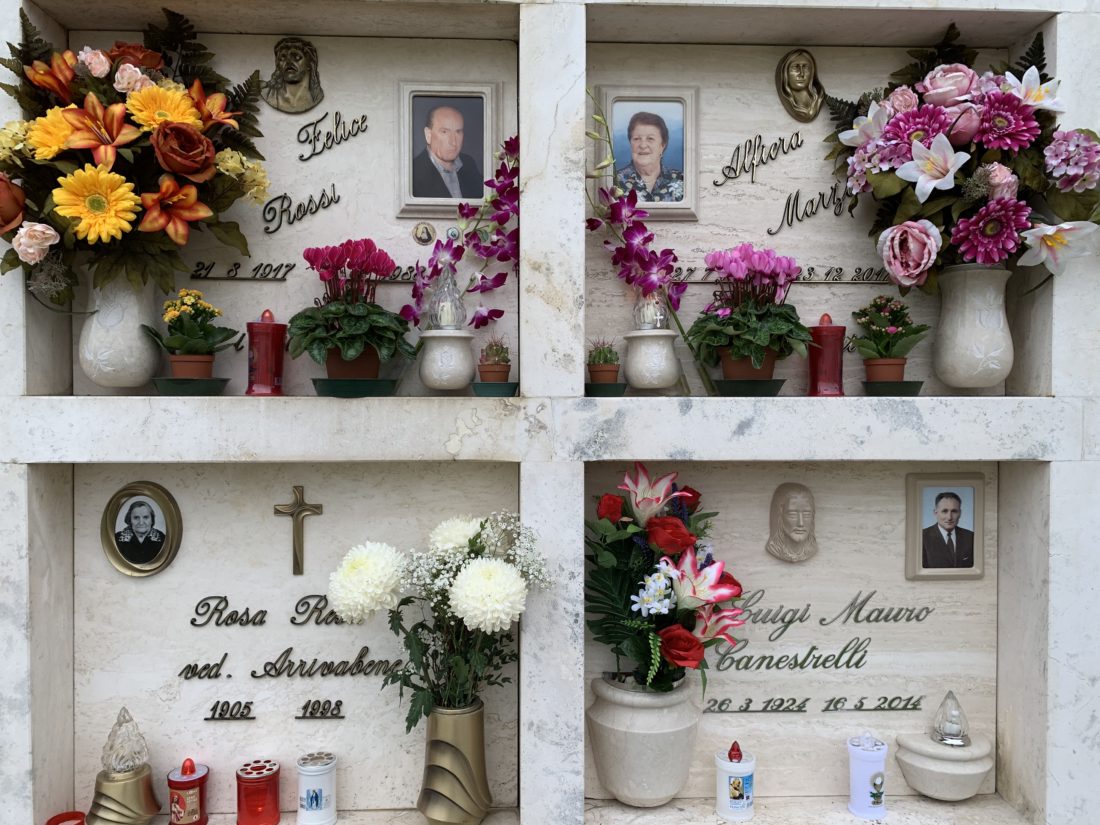
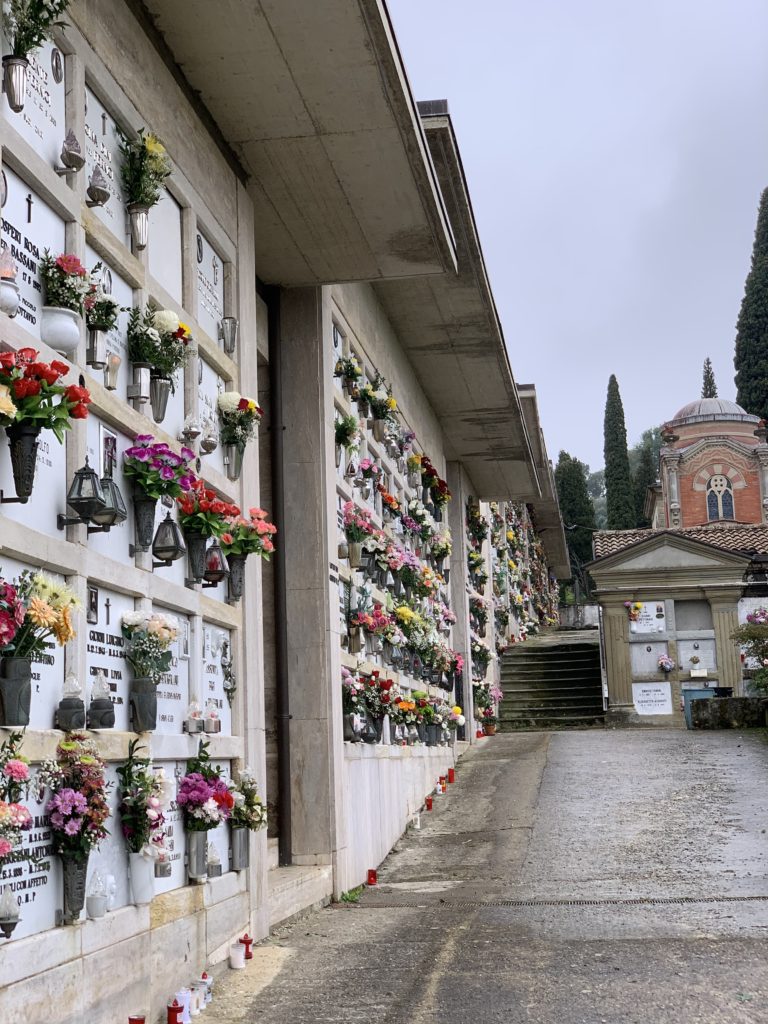
The main focus is November 1st, All Saints Day, and November 2nd, the more inclusive All Souls Day, both of which are full-on holidays with most businesses closed. All the action happens at the cemeteries. Right before the holidays cars are double parked around every local cemetery (even the smallest hamlet has one) so that families can come and decorate the graves with new fake flowers, battery-operated candles, photos, and small ceramic figurines of angels and the like. (Many graves touchingly come in pairs of husbands and wives.) The supermarket display of plastic and fresh flowers dwarfs the section of costumes, and tents selling flowers are set up around the cemeteries. Traffic around our nearby cemetery is routed in a one-way direction to prevent collisions. Inside the walls of the cemetery it is a cheery, convivial scene with crowds of people of all ages talking and laughing and tending the graves. I wrote about the Italian approach to death, cemeteries, and recycling graves in last year’s Itch.
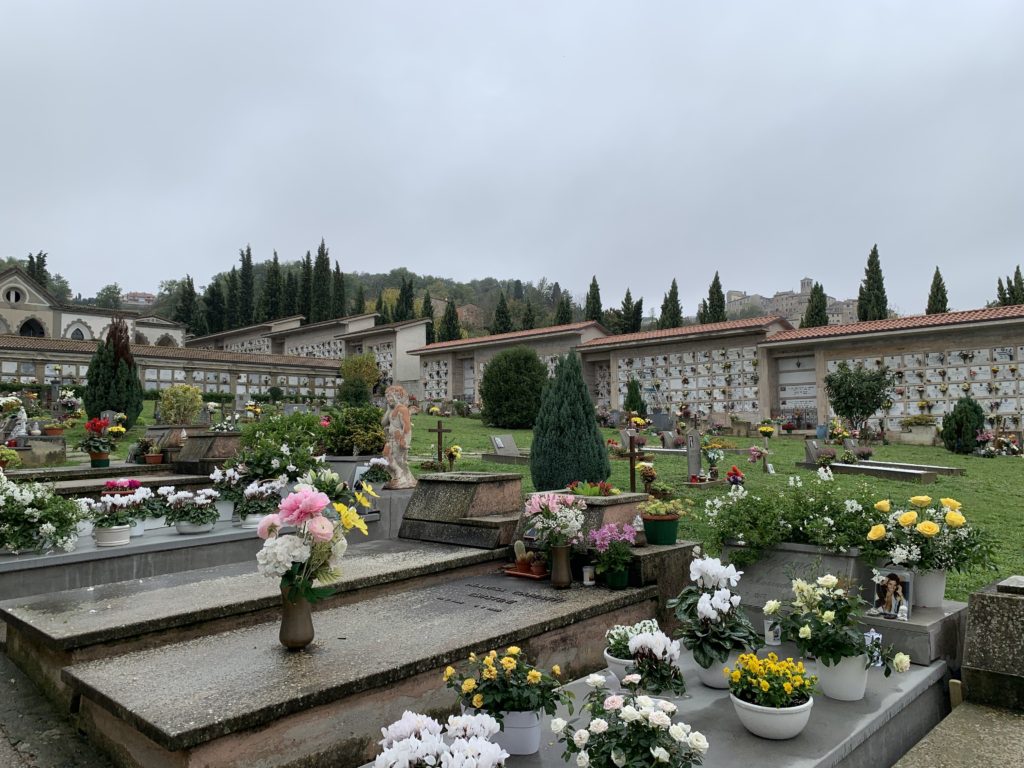
The very spiffy graves after much work by the families.
It’s a revelation for me to see the trivialized American Halloween tradition reunited with its more ancient and profound roots about death and those who have passed beyond our worlds.
It has even started to make me question my plan for eventual cremation and wondering if it wouldn’t be nice to have a little niche, right beside John, with a photo and plastic flowers and perhaps a clay figurine of Lola. That way if I do wander into the butcher, in a less than fleshy form, demanding a sausage on the night of October 31st, I will know my way back home on November 1st.
Postcard: Making the McDonalds
In a swirl of pre-production chaos dinner looms and I go down to the nearest butcher shop knowing I can get everything I need to make hamburgers. There are about six people in line in front of me and while I wait I grab the only package of hamburger buns on the shelf. After about five minutes it is my turn. The woman behind the counter carefully cuts off pieces of beef, from cows raised nearby, to get the right mix of lean and fat, seasons it all, puts it through the grinder, then shapes and presses patties, carefully separated by paper and wrapped. While this is happening a line of about six people grows behind me. I ask for some cheese from the big block and she asks how thinly I want it sliced. I point to the burger patties and buns and she says with a big smile “Fai il McDonalds questa sera?” (Are you making the McDonalds tonight)? I laugh back and answer “si”.
The six people in line behind me can’t contain themselves and all jump in with a rush of opinions about McDonalds. The man behind me says that McDonalds would never have beef of this quality, and that you can’t even compare the two. The woman next to him says that she has heard that the buns McDonalds uses are often several years old. (I do not point out to her that the ones I just got off the shelf had probably been there since World War II.) Someone else volunteers that they have never been. I calmly assure everyone that even though I am American I am not a fan of the chain and much prefer to make my own McDonalds at home.
There is a palpable release of tension at my admission and with a cheery round of “ciao” and “buona serata” I am on my way into the dark night.
An Italian’s DNA surprise
Itch is delighted to feature more from our Italian abroad, Gianna della Valle, with ideas about how to live more like an Italian no matter where you are. She has made a study of how to bring elements of the Italian way of life into her adopted, more frenetic homeland.
As an Italian living in London people ask “Where are you from?”
Easy for me to answer as my family, for many generations, came from the same hamlet in northern Italy. My father and my mother were neighbours and my grandparents and their grandparents and their grandparents knew each other for as far back as anyone could remember. That’s Italy for you. We have roots. Family trees. It means families are like trees, solidly rooted in places. People and generations may be the leaves and branches but the family is the tree. A tree stubbornly planted in front of that hill. Nothing to do with aristocracy or anything fancy. Simply, we are from there. And in the house we can find things left by a great grandparent (or a great great great) that have survived layers of renovations and are a reminder that we always leave something behind. Better it be useful.
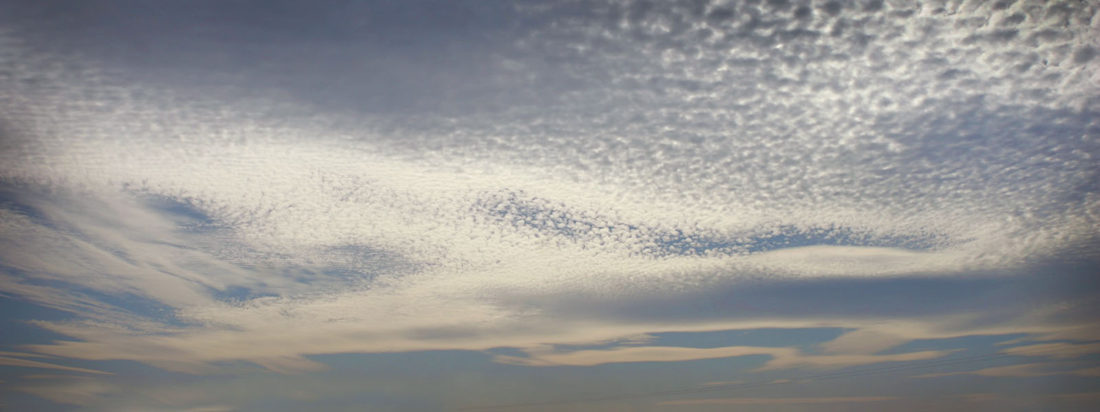
Then I came along and at some point in my twenties decided to pack and followed the North Star, which after some years in Germany led me to London. I still feel the guilt. And after decades I am still given “the traitor treatment” when I go back. “Italy is so perfect and beautiful,” the logic goes, “why did you leave? There were no wars or major disasters. There was absolutely no reason. Why?” I must say, in my defence, I did ask my grandfather for his blessing before starting this adventure, as I always sought his wisdom. And his simple question was “What is it that you like so much over there?” I thought for a few seconds and my answer was “because I look at the sky and the clouds are always running.” “Well then, go.” And that was that. The clouds are always running in England – unlike the Italian sky where not much moves in days. And the constant breeze, the smell of water and wet grass. From the first time I was in London it felt like home. And so it has felt ever since.
A couple of years ago I was having drinks with some colleagues and the topic was DNA testing. A few of them had tried it and it unlocked new learnings. I laughed. I certainly would not need the results to tell me where I was from! I definitively knew! Anyhow, there is nothing like a pub challenge, and there I was with my saliva in a tube, sending it somewhere unknown.
I was due for a shock when the results came back. There was not a drop of Southern European blood in my body. I was from the North, up to 30,000 years ago my ancestors were from somewhere North – between Denmark and England. I thought this must have been a mistake. So I sent a sample from my mother in a way that would not in anyway highlight we were related. And my father. No, niet, nada. Not a single whiff of truly Italian stock in our tree that seemed so stubbornly planted in front of that hill! But I was truly the daughter of my mother and my father (so no surprises there, in case you wondered). I reach out desperately to other people with more obviously diverse backgrounds – and yes, their results were correct. So it was true. I was ultimately from a place where the clouds are running.
What about my parents? What did they think about it? Nothing really — it’s easier to believe what we could see and touch about our ancestors’ belongings, sprinkled around our house like fairy dust, than something so far away and questionable like a saliva swap sent to a faraway lab in Canada.
When we look with a horizon of 30,000 years the history of humanity is one of change and movement and that’s the fascination of DNA tests. There is so much tension today about where we are from. Shouldn’t we all just look up at the clouds in the sky?
The Artist Formerly Known as Mommy
(or “And Then There Were None”)
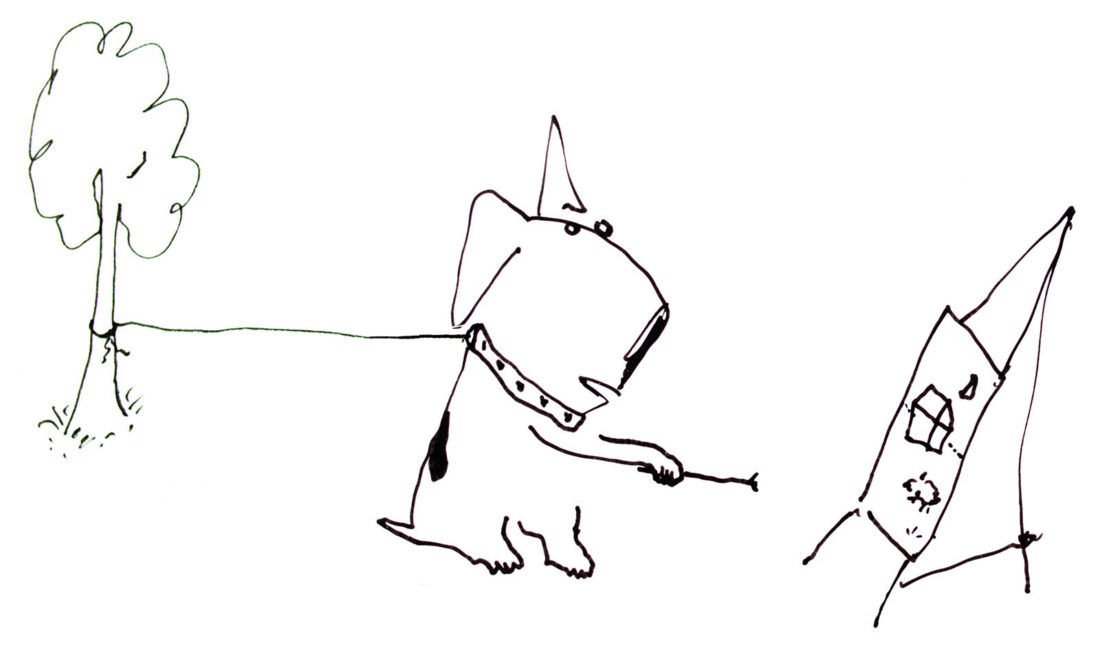
I am ripe for a personal rebranding. This summer before both kids left for school in London I told the family to prepare to get to know someone new — The Artist Formerly Known as Mommy. The kids looked at me with a mix of annoyance, fear, fascination, and pity. “You know, like Prince,” I added. “After he became a glyph.”

I remember the moment when my current identity started. When “Nancy” became “Mommy.” I was pregnant with Donella and John and I were taking a vacation in Italy. We were eating at a very nice restaurant when I started to cry. For a moment I wasn’t at all clear why tears were running down my face as I was thrilled to be having a baby. Then I got it and managed to sputter out to John that I was sad to be saying goodbye to Nancy while I morphed into Mommy.
Now the moment has come to change course again. It’s intimidating. Such a wide open plain of possibility. Going back to the old Nancy doesn’t seem quite right, nor does remaining Mommy. Hence TAFKAM.
Then I get a series of texts from Sebastian needing IKEA-level blow-by-blow instructions about how to log onto Vueling, check in, and get his boarding pass for his flight back to Italy. And a call from Donella with the latest ups and downs of dorm life.
A friend recently told me it’s not about the “or” it’s all about the “and.” (Ironic advice as I remember all the work with did with Carly Fiorina at HP when the and/or thing was a mantra that she’d frequently center speeches around. I scoffed loudly but it is kinda true.)
So the true art for TAFKAM will be how to blend the two prior manifestations into the future in the right mix. Shedding some things while growing others. And so much around getting to the next level of Italianness.
A friend was recently reading Norah Ephron’s I Feel Bad About My Neck and shared this quote.
“The day finally comes. Your child goes off to college. You wait for the melancholy. But before it strikes—before it even has time to strike—a shocking thing happens: Your child comes right back. The academic year in American colleges seems to consist of a series of short episodes of classroom attendance interrupted by long vacations. These vacations aren’t called “vacations,” they’re called “breaks” and “reading periods.” There are colleges that even have October breaks. Who ever heard of an October break?”
Gotta go to pick up Sebastian at the airport. He starts his TWO-WEEK October break today…
Dinner theater and the Genoa disaster
Few Italians will forget where they were the moment they heard about the collapse of the Ponte Morandi bridge in Genoa, which killed 43 and left over 600 people homeless. It hit a nerve beyond the sheer horror of the disaster. Italians are master engineers and pride (I’d venture to say even define) themselves on the beauty and engineering elegance of their creations, especially in the heyday of the Italian economic boom of the 1950s and 60s. This 1963 bridge, designed by Riccardo Morandi, was internationally famous for its beauty, but also for its bold use of structural concrete, and the collapse was a blow to national dignity.
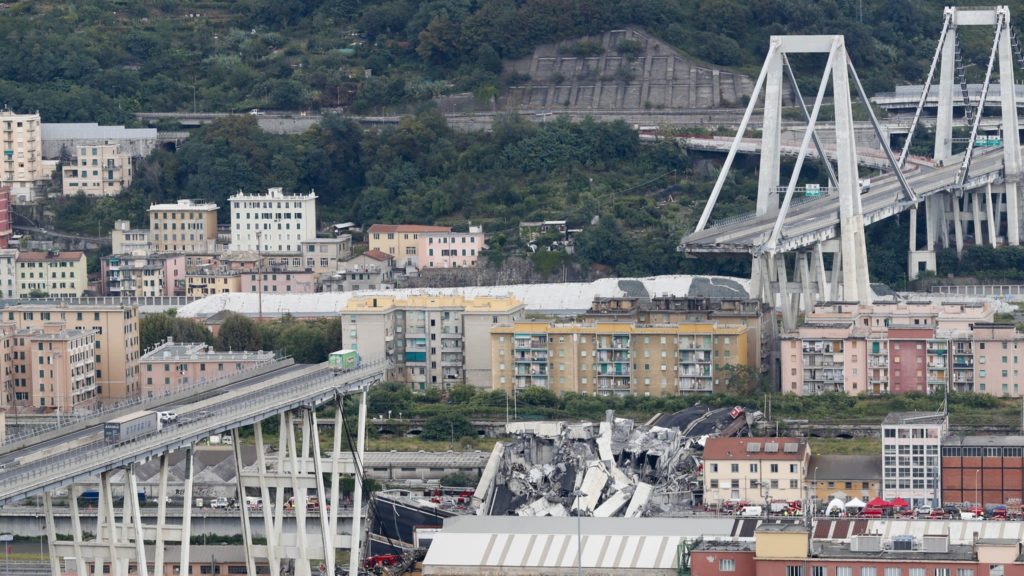
(image from the Financial Times)
But beyond that the collapse speaks to the Italian belief that corruption is endemic and that the common people pay the price. The bridge was maintained by the Autostrade per l’Italia company (largely owned by Benetton) which is a hugely-profitable monopoly running the network of expensive to use, but fast, roads in Italy. Turns out the inspection company has ties to, and shares offices with, the company they are chartered to inspect and regulate.
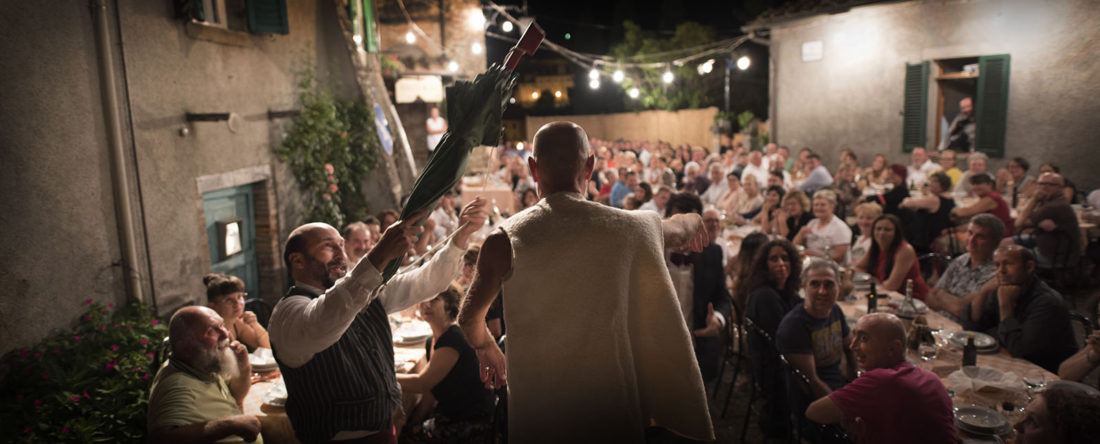
Which brings us to Anghiari’s annual play, the Tovaglia a Quadri, dinner theater created, produced, and performed by a small team over a course of ten nights in August. Tovaglia a Quadri is written weeks before the performances so the topics are fresh, and it serves as an annual hard look in the mirror about the issues challenging Italy and village life. (Here’s Itch on last year’s play about how Amazon is changing local life.)
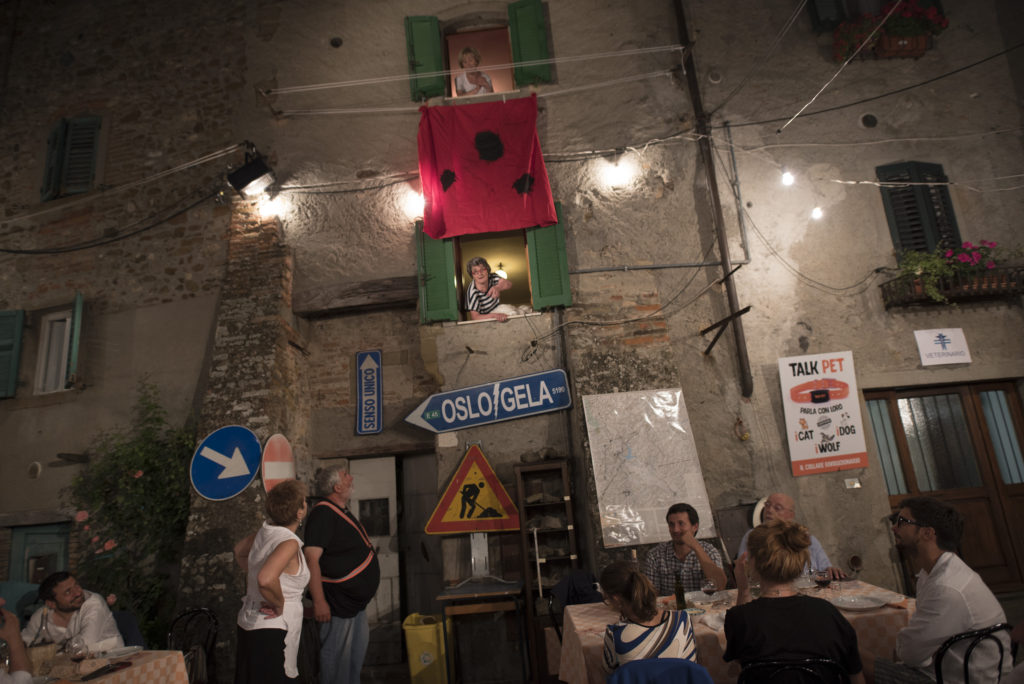
(all photos from Tovaglia a Quadri, including at top, courtesy of Giovanni Santi.)
This year, with the Genoa disaster looming in the background, they wrote about our local brush with dangerous bridges. The E45, which is the longest north-south freeway in Europe (starting in Alta, Norway and ending 5,190 kilometers away in Gela, Sicily) runs right through our valley. The section that goes to the Adriatic coast passes over some really high, long viaducts. Soon after the Genoa disaster a truffle hunter in a forest under one of these massive bridges happened to look up and notice the horrible condition of the bottom of the roadway and took some pictures. The result was this major artery of Europe being completely closed for months while the situation was assessed. (It’s now been “solved” by opening only one lane, slowing the speed limit to a crawl, and limiting heavy trucks. Every time I have to drive it I hold my breath.)
The irony for the writing team of Andrea Merendelli and Paolo Pennacchini is that where the truffle hunter took the photos was on a 2,000 year old Etruscan road, still viable, and used even today for the migration of animals from the mountains near us to Maremma on the Tuscan coast, called the transumanza. The bridge that is failing was built only 25 years ago. And there’s the added dimension that our valley shut a flow of traffic, goods, and ideas from across Europe. (Politics, anyone?) The title of this year’s play is ViaDotta, which is translated as viaduct, but also via, or way, of dotta, which is between wisdom and knowledge.
The plot follows from there, including a scheme from a local entrepreneur to showcase the transumanza to local tourists, against the will of the locals who love their pets but are not in favor of other domesticated animals being in such close proximity. In a very funny scene the entrepreneur insists that the shepherd he hires change from his usual attire of a t-shirt and sweats into one that the tourists would associate with the calling—scratchy white wool.
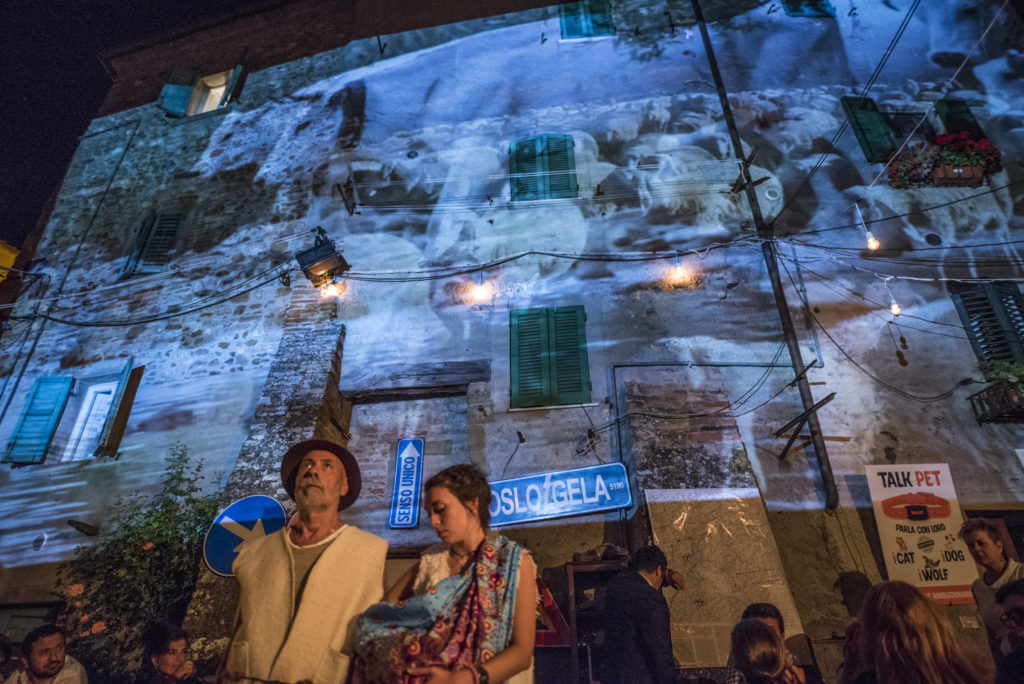
I was particularly interested in sharing this with you when I saw that a New York Times article about this year’s topic—the transumanza—was on the most popular articles list last week. I also saw a video about it at a London Tube station this week.
Just for the record, Anghiari got there first. I knew I’d be on the cutting edge when I moved to a tiny Tuscan village.