

Will I Ever Really Be Italian?
I don’t know if I am crafty enough for this.
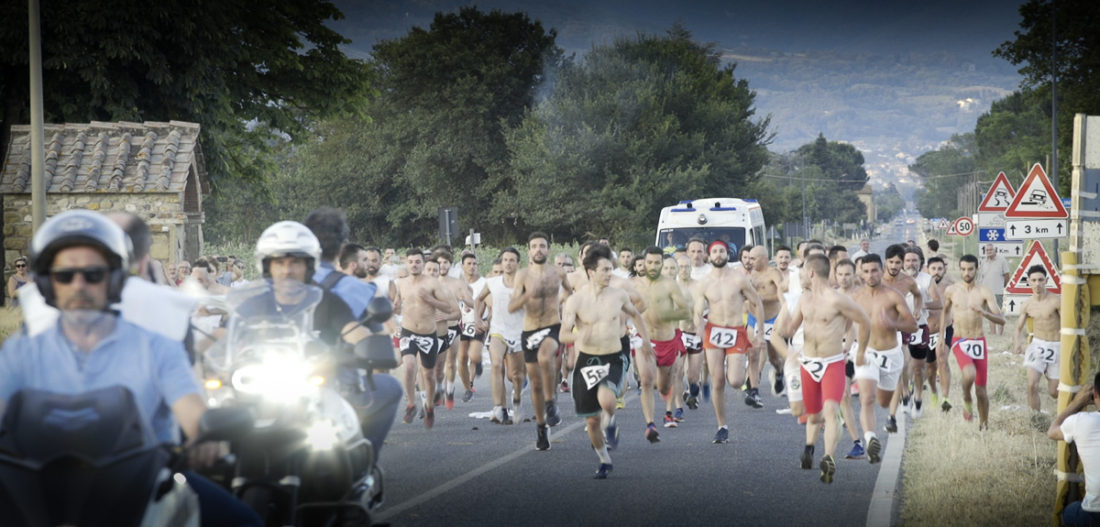
Siena gets a lot of attention for its annual horse-racing palio, but every June 29th the village of Anghiari hosts its own Palio della Vittoria, or Race of the Victory, to commemorate the Battle of Anghiari. It’s one of the oldest and most famous foot races in Italy, and according to the Corriere della Sera newspaper, the craziest.
The Battle of Anghiari, fought in 1440 between Florence and Milan, is known for three things: Florence’s victory cemented its dominance and set it up to be the powerhouse of the Renaissance; the battle is the subject of Leonardo da Vinci’s lost painting (believed to be his best work); and Machiavelli wrote about it, reporting with disdain that only one soldier died—and that’s because he fell off his horse.
Our palio is held every year on the anniversary of the battle, starting in 1441. It was originally a horse race, but was stopped in 1827 because it had become so violent that one of the jockeys was killed. The race was held periodically during the late 1800s through the early 1900s as a foot race, and is now an annual event.
The palio is its own sort of battle. Every year, around 20 teams of runners from towns across Italy—but only ones that had soldiers in the original battle—are invited to participate. Each team has five runners. The starting line is at the battlefield site in the valley, and the finish line is at the top of a perfectly straight road that goes uphill with an incline of 18%. The race covers 1440 meters (nearly a mile), and lasts just over five minutes.
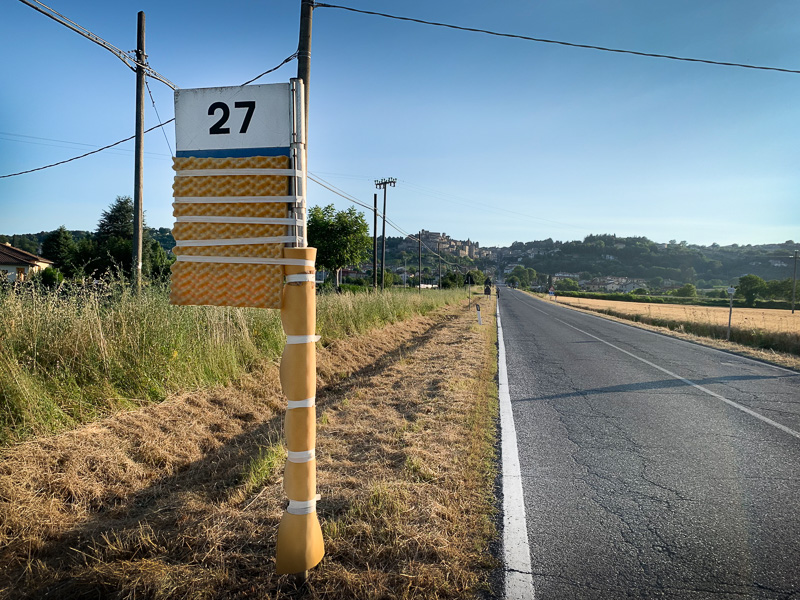
The ascent is intimidating, particularly in the heat of late June, but what the race is most famous for is its physical contact. Runners wear tear-away jerseys that are shed the moment the starting gun goes off, so they are harder to grab. The street signs are padded before the race. An ambulance follows close behind.
One year, we watched from the starting line, and the amount of shoving, chasing, and seizing of runners was rather shocking. Each team has a “The Rock”-sized person whose job is clearly not sprinting. One infamous race moment happened a few years ago when a beefy Anghiarese runner positioned himself next to one of the lean, fast runners from another team, who was favored to win. Right before the starting gun went off, he said, “You will start when I say you can start.” The other runners took off, the favored runner and his “companion” walked a few hundred feet, and then the big guy said, “Now, you may start.”
This year our Anghiari team had a new strategy. They trained harder than they ever had, focusing their workouts on sprinting up hills. Cold plunges in the freezing headwaters of the Tiber River also played a big part, according to the team. One of the men who trained with the team, who recently ran a marathon, said that the uphill sprinting pace was so intense that he simply wasn’t fast enough to be in the final five.
Trained and ready, the team deployed their fitness in a devious way. They were fast enough to break away immediately from the melee at the start, and the five sprinted uphill at a blazing pace. But they weren’t alone—several runners from other towns were in close pursuit. About a hundred feet from the finish line, four of the five runners from our village turned around and blocked the competing runners. The last Anghiarese runner continued on, unhindered, to win.
Watching this from the sidelines was shocking. I asked some of the runners if our village was resented for this move, but they said apparently not. In fact, they’d just been invited to compete in a race in a nearby town. All is fair in the Palio, and one of the most esteemed personal traits in Tuscany is to be furbo—tricky, cunning, or sly. Oddly enough, when I was pouring over local coverage researching this post, there was no mention of this unusual strategy.
Being furbo extends beyond one’s own team. Sometimes teams that know they can’t win in a particular year due to the health of their runners will work together with other towns to help them, with the understanding that the favor will be returned in a future race. These alliances are kept secret at the time of the race. Danger could come from anywhere.
The race is followed by a seated, candlelit dinner for 1,000 and is famously boisterous. The celebratory feast takes place along the village walls, which along with the long, straight, steep street that the runners had just conquered, are the defining features of Anghiari.
Our village knows how to throw a party—so much that the local government has a party throwing office, called the pro loco—and for this event they put hundreds of candles along the top of the waist-high protective railing, and dozens of banquet tables.
One year, the race and banquet happened right after I had been sworn in as an Italian citizen—by our mayor, bearded and wearing his formal sash—in the ancient town hall, which includes a medieval dungeon. Holding a second passport was simply not something that happened to Nancy from Clearwater, Florida, and even though I’d been working toward this for years, I was dumbfounded. I decided to celebrate this milestone by volunteering to serve food at the event, something outside my comfort zone. I’d had many menial jobs in my youth, but none in food service; and I try to avoid mobs of sweaty, testosterone-fueled men consuming a lot of wine whenever possible. But this I wanted to do.
As had often happened during this adventure, one step forward is followed by a sharp jerk on the leash by reality. Serving food at this event was a real insider thing to be doing, but even though I was now officially Italian, I still felt like an outsider. I looked around and realized that no matter how long I live here I will never be able to know the subtle nuances of belonging—loyalty to your village, town, and neighborhood, and the deep rivalries that go back centuries. I will never be of this place.
But deep in my heart I am not sure that, even if it were possible, I would want to be a native. I like my identity as both a local and an outsider. I am finding pleasure in the discovery of these Italians, and ultimately, of myself. Being immersed in such a different way of life seems to help the mirror of self-reflection become even sharper, in addition to providing the daily delight of discovering more about my Italian home. Living in my native culture felt like the mirror was a little too close, when an eye or nose is large but the whole is out of focus. You know every pore only too well.
For someone who has always craved roots and safety, I find my comfort with my half-in state unexpected. Part of my connection to this place is physical. We have restored and take care of a house and I feel so lucky to share its history for what is, for the house, merely a brief moment. I once calculated that if we stay here another couple of decades, we will have only been its inhabitants for a tiny fraction of its existence.
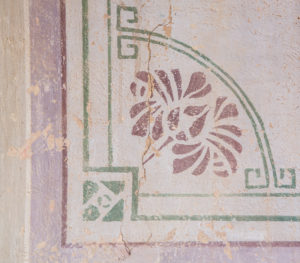
An Etruscan road runs through our land. The house is ancient, the core was an early medieval defensive tower—we just discovered it is probably from the 1100s. Staring at the frescoes in our bedroom, which we painstakingly revealed over months with spatulas scraping away layers of modern paint, and thinking of all the others who have stared at the same designs before they were covered over for hundreds of years, gives me a deep sense of calm. Our love of this place, the hundred or so trees we have planted, the hundreds more we care for, the house we brought back to life from abandonment, the very soil we are allowing to recover, will hopefully last long after us. And that is a real sense of place.
Despite the self-reflective undercurrent of the evening, I had a great time serving these tables. The yelling back and forth between tables, sweaty mass of mostly men, and plates piled high in my arms were definitely intimidating, but everyone was smiling, friendly, and encouraging of my Italian. I kept the food, and wine, flowing.


